Study: Most Of America’s Paint-Only Bike Paths Are On Our Deadliest Roads
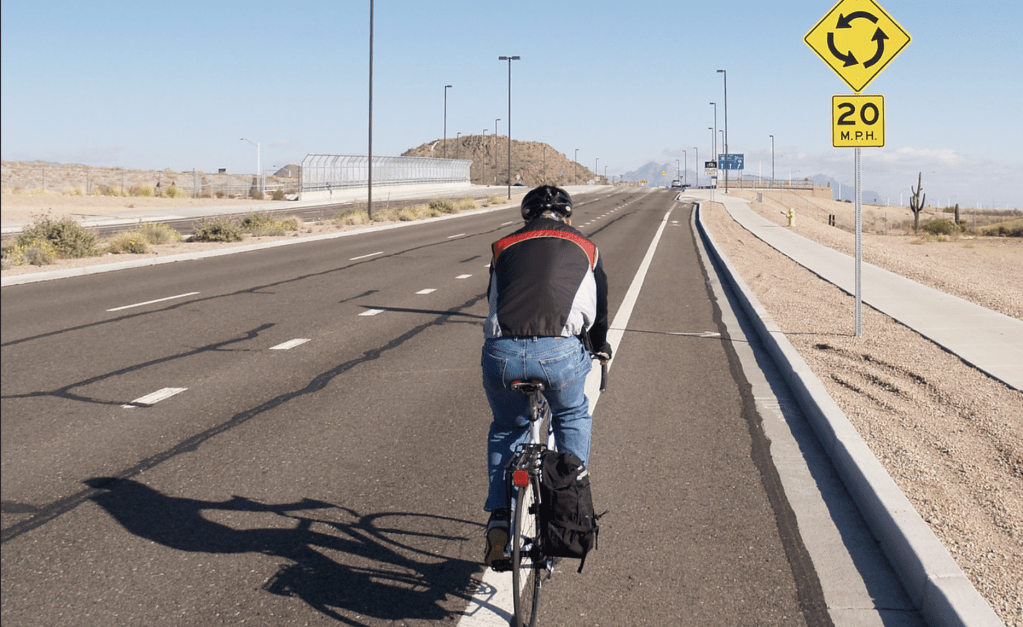
The largest categorial of American “bike lanes” are little more than lines of paint at the edges of deadly roads — and that lack of quality infrastructure is keeping many would-be riders out of the saddle, a new study confirms.
Roughly 61 percent of paint-only bike paths in America are considered “high stress” corridors, meaning they’re sited on the kind of fast, multi-lane arterials where only the most-confident cyclists feel comfortable riding, the Journal of Cycling and Micromobility Research study found. Less than 40 percent, then, are “low stress,” meaning they’re located on the kind of slow-speed, single-lane neighborhood roads that organizations like NACTO say are the only routes that are appropriate for the paint-only treatment.
Considering that 77 percent of all on-road bicycle “infrastructure” in America is nothing more than a white stripe on the edge of the pavement, that means the single largest category of so-called “bike lanes” in the U.S. is barely deserving of the name — and that could be warping the public understanding of what good cycling infrastructure can be.
The study was initially inspired by lead author Michael Garber’s Colorado commute, during which he routinely saw bikers braving an unprotected lane on a 45-mile-per-hour road — and wondered how many paths just like it were endangering riders in other communities, too.
“I was always thinking, ‘I hope they survive,’ because it doesn’t seem like the most welcoming place to ride a bike,” he added.
Now a postdoctoral researcher at UC San Diego, Garber quantified the percentage of bad bike lanes in the US with data from People for Bikes, which ranked the “stress level” of all cycling infrastructure in 442 U.S. cities.
And that stress isn’t just in riders’ heads; one of Garber’s earlier case studies in Atlanta found that paint-only lanes were actually associated with more crashes than roads with no bike lanes at all, in large part because ATL sited so many of those bike facilities on multi-lane arterials, without so much as a flex post to tell drivers to keep out. His newest analysis found that in some cities like Houston and Columbus, as many as 87 percent of bike lane mileage was designed in a similar way.
If that means the average American sees only the worst type of bike infrastructure on their communities’ roads, it’s no wonder why so many of them are hesitant to support bike lanes, period.
“A lot of people see these [unprotected] bike lanes and they intuitively understand, ‘That’s not a safe place for me to ride my bike,'” Garber added. “It probably does shape the perception of what a bike lane can be, because they’re just so common.”
Moreover, Garber points out that definitions of “high” and “low” stress bikeways vary across the transportation profession, and that not every rider would actually comfortable riding on some of the “low stress” corridors in his study, because some have speed limits set as high as 25 miles per hour. NACTO recommends that paint-only treatment be used only on roads that are signed for 20 miles per hour or less.
“That’s an ideal scenario — but in the United States, we barely have any roads that have that speed limit,” Garber added. “If the bar were set at a speed that low, pretty much every single [paint-only] bike lane in the US would be classified as ‘high stress.'”
Of course, not every community is putting its riders in harms way with paint-only lanes. The study found that high-stress bike paths were far more common in the south and west, where around 65 percent of all bike lane mileage earned that dubious distinction; in the northeast, only 25 percent did, and in specific cities, the total was even lower, like Chicago (21 percent), Denver, (19 percent,) and New York City (10 percent).
Interestingly, the overall roadway composition of a city did not correlate with a high percentage of high-stress bike lanes, meaning at least some transportation officials had the good sense not to put paint down on dangerous roads even if they have a lot of multi-lane arterials. And Garber hopes more cities could soon join that group, since the American Association of State Highway and Transportation Officials released a major update to its bike lane guidance in 2024, and now specifically advises against putting “conventional” (read: paint-only) paths on highly trafficked, high-speed roads.
“[It basically says], ‘The higher speed and volume of a road, the more protective the bike facility should be,'” Garber summarized. “So moving forward, if transportation engineers are following this guidance, they ideally won’t be putting bike lanes on multi-lane, high-speed arterials anymore — and if they do put a bike lane on that kind of a road, it would be a protected bike lane.”
Since the AASHTO update doesn’t mandate that states replace their worst lanes with real protection, Garber acknowledged that the share of paint-only paths on deadly roads is unlikely to fall dramatically anytime soon. Still, he hopes that we’re in the midst of a shift in the conversation about what good bike infrastructure should be — and eventually, that will reshape perceptions and communities.
“It will probably take a while for practice to catch up,” her said. “But hopefully this is the highest prevalence we’ll see, and it goes down from here.”

Read More:
Streetsblog has migrated to a new comment system. New commenters can register directly in the comments section of any article. Returning commenters: your previous comments and display name have been preserved, but you'll need to reclaim your account by clicking "Forgot your password?" on the sign-in form, entering your email, and following the verification link to set a new password — this is required because passwords could not be carried over during the migration. For questions, contact tips@streetsblog.org.