Traffic Safety or Culture War? Trump’s Desire to ‘Own The Libs’ Undermines Safety
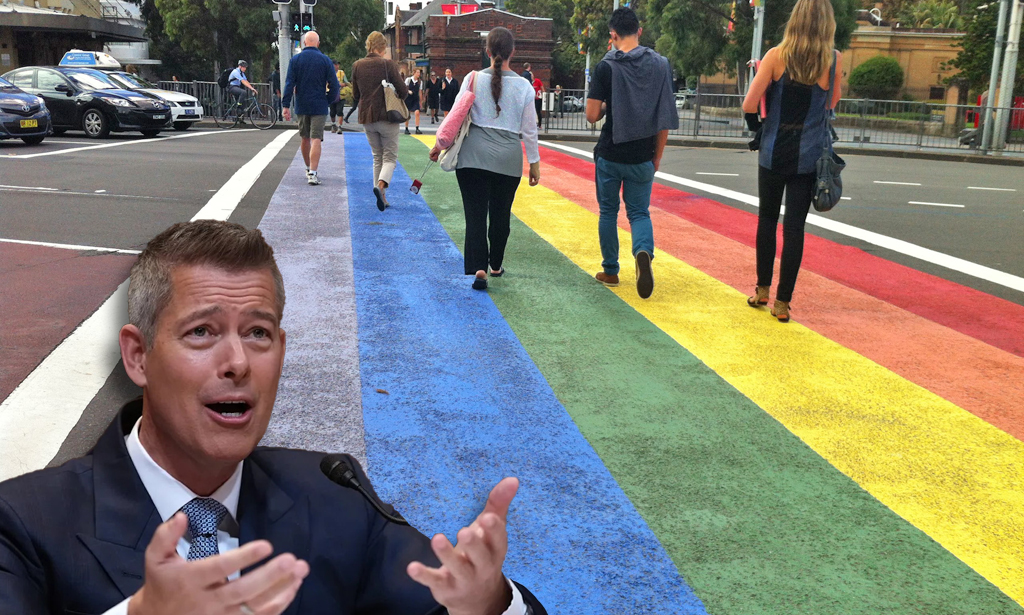
A culture war has erupted in the streets of America. Or, more precisely, on the streets, where cities are ripping out their rainbow crosswalks in response to federal direction to remove “political” artwork from roads.
The directive came down on July 1 in a memo to state governors from U.S. Secretary of Transportation Sean Duffy. Ostensibly focused on safety, the letter advocated for “consistent and recognizable traffic control devices including crosswalk and intersection markings.” Any impression of cultural neutrality was quickly negated by the accompanying tweet:
States and cities were quick to respond. First up were two places that generally won’t miss a skirmish in the culture wars, Florida and Texas. Both states’ Transportation departments issued memos amplifying Duffy’s message and its financial intimidation. Municipalities were instructed to either remove their decorative pavement markings or lose state funding.
Just in case the intention was not clear, the first rainbow crosswalk that FDOT chose to remove — by stealth overnight, and without city approval — sat directly in front of the Pulse nightclub, the gay bar where 102 patrons were shot, 49 fatally, in one of the worst hate crimes in our nation’s history. Other colorful crossings have been removed across the state, both by FDOT and by Florida municipalities fearing loss of important road-maintenance dollars.
In Texas, rainbow crosswalks have disappeared in Houston and Galveston, with other cities stating their intention to comply. And it’s not just rainbows. Because the state orders have attempted to sound politically neutral, any crosswalk that cannot be found in the Manual of Uniform Traffic Control Devices — a notoriously old-school, out-of-date engineering bible — is potentially on the chopping block. In August, Coral Gables pulled out artistic crosswalk murals by the late Venezuelan artist Carlos Cruz-Diez, installed during Art Basel in 2017 at a cost of $180,000.
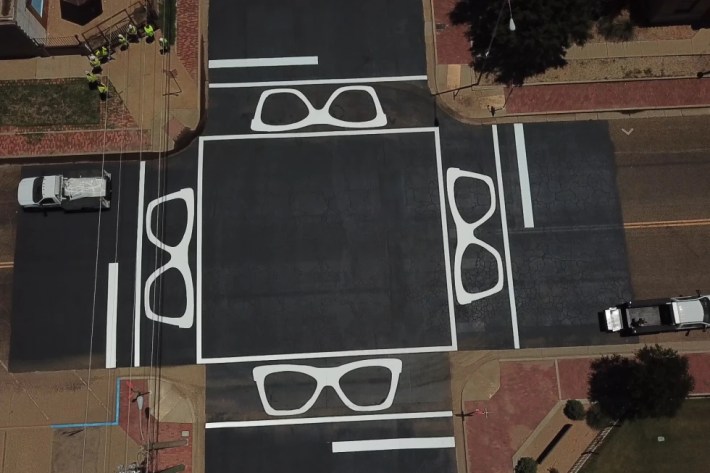
Struggling to follow federal and state direction to the letter — in perhaps a city’s most painful self-own in years — the City of Lubbock announced in November that it was ripping out its iconic Buddy Holly eyeglass crosswalks.
Juan Lozano of the AP put it perfectly: “That’ll be a day that will possibly make them cry.”
Cities in other states are getting into the act. In Salisbury, Maryland, Mayor Randy Taylor presided over the Nov. 10 removal of the city’s rainbow crosswalks. A registered Republican in a purple county, he insisted that his decision had “nothing to do with how I feel about the LGBT community.”
In response, some left-leaning places are making it clear that they have no intention to comply with Sec. Duffy’s order. Soon after FDOT’s removal of the crosswalk outside of the Pulse nightclub, Atlanta announced that its well-known rainbow crosswalks were there to stay. In December, Chicago began re-installing 11 colorful crosswalks citywide. Chicago alderman Bennett Lawson averred that “while other states are erasing LGBTQ+ history from their streets, Chicago is doubling down on inclusion.”
But one thing has been lost: colorful crosswalks save lives.
For some time now, pedestrian safety advocates have argued against conventional engineering practice in favor of colorful street art as a way to increase driver awareness and make roads less deadly. Based on early evidence, the Bloomberg Philanthropies launched their Asphalt Art Initiative in 2019 and have since supported 100 such projects across North America and Europe. More than 80 of these are complete, and the results are compelling.
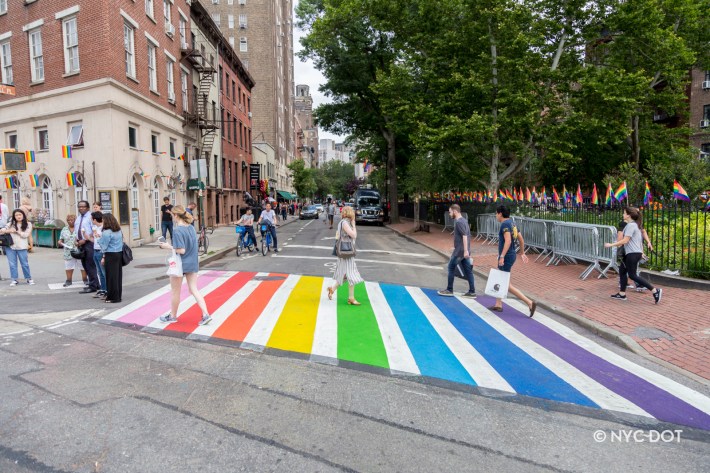
Former New York City Mayor Mike Bloomberg famously said, “In God we trust. Everyone else, bring data.” Here, the data came from 17 U.S. cities and compared crash statistics before and after the installation of street design interventions, including artistic crosswalks, intersection murals, and painted curb extensions. In these projects, total crashes decreased by around 17 percent, injurious crashes dropped by approximately 37 percent, and the rate of crashes involving pedestrians or other vulnerable road users was cut in half. These numbers represent lives saved by paint.
The study also examined before-and-after video footage of five American locations. A detailed analysis found that the rate of pedestrian crossings involving a potential conflict with drivers fell by roughly 25 percent, drivers immediately yielded to pedestrians 27 percent more frequently, and approximately 38 percent fewer pedestrians jaywalked through intersections.
Some of the individual results were striking. In Durham, an installation next to an elementary school brought about a 30-percent decline in potentially dangerous conflicts between drivers and crossing children. In Richmond, Virginia, “close-calls” and other dangerous encounters were reduced by 56 percent.
Other Asphalt Art Initiative projects, not included in this study, have produced similar improvements. In Passaic, N.J., instances of drivers failing to yield to people walking and cycling fell by 55 percent. In Kansas City (Missouri), average intersection speeds decreased by 45 percent. Driver speed is the most decisive factor in lethal versus injurious crashes.
The experience has been consistent from coast to coast. After the insertion of rainbow crosswalks in Seattle’s Capitol Hill, one city engineer remarked, “For these locations, we’re seeing a reduction in pedestrian collisions to the point that they’re not really happening.”
The evidence is clear. However you feel about colorful crosswalks, they make roadways safer for pedestrians, drivers, and cyclists alike. Whichever side you support in our diversity culture war, one would hope that you agree with Sec. Duffy that “roads are for safety,” and that we should follow the evidence where it leads.
In his letter to U.S. governors, Duffy stated that “We are getting back to the basics — using data to guide decision-making and prioritize investments.” If that is truly the case, why is he spending federal dollars ripping out crosswalks that reduce crashes? And who is truly playing politics here, at a real cost of human lives?

Read More:
Streetsblog has migrated to a new comment system. New commenters can register directly in the comments section of any article. Returning commenters: your previous comments and display name have been preserved, but you'll need to reclaim your account by clicking "Forgot your password?" on the sign-in form, entering your email, and following the verification link to set a new password — this is required because passwords could not be carried over during the migration. For questions, contact tips@streetsblog.org.