Commentary: US DOT’s Misguided War on Bikeways
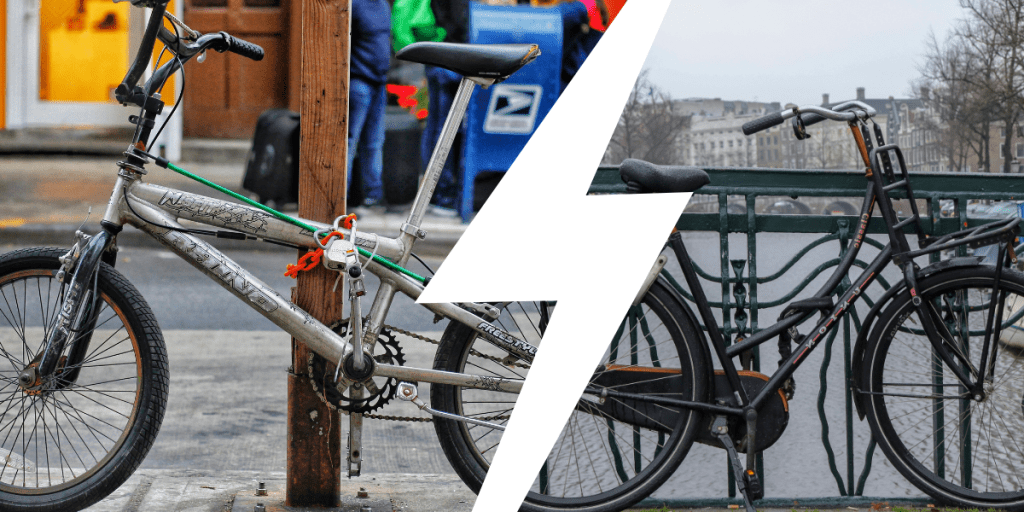
The current U.S. Department of Transportation defends its hostility to bike lanes and trails by doubling down on the myth that bike infrastructure does not work. Of course, DOT knows full well that bike infrastructure does work.
As well-documented by Kea Wilson in her April 2025 Streetsblog article, bike infrastructure does not increase congestion. But it does save lives and allows more people to choose a non-polluting travel mode that reduces (or eliminates) the cost of car ownership (which averages about $12,000 per year per car).
In September 2025, DOT announced it was rescinding approved grants for bike infrastructure using vague reasons such as ‘hostile to cars’, ‘could ‘impede vehicle capacity and speed’, and runs ‘counter to DOT’s priority of preserving or increasing capacity for motor vehicles.’ By defunding cycling infrastructure, DOT has chosen to reject decades of the department’s own research on the benefits of pedestrian and cycling infrastructure.
On November 1, 2025, Albuquerque, New Mexico sued DOT for rescinding a $11.5-million grant for the Albuquerque Rail Trail, a project that does not involve any reductions in car lanes but simply unites various communities in the central city with a multi-use trail accessible to people of all ages, abilities and incomes. The city’s lawsuit states that DOT basically replaced the grant criteria established by Congress with its own mission to accommodate cars.
Secretary of Transportation Sean Duffy rejects the success of people-friendly mobility of many cities in Europe with the sweeping generalization that Europeans have a different mentality. But my research of 30 cities in Europe and America reaffirms that Europeans were poised to adopt an American-style, car-dominated society after WWII. By the 1960s, many European cities made a U-turn as the death toll from traffic accidents rose and city leaders throttled back on allowing cars to completely dominate their roadways.
The leading European cities prove that walking, cycling, and transit can accomplish much if not most of peoples’ everyday transportation needs. Amsterdam, where 68 percent of all work and school trips are by bike, is not an anomaly. Almost half of all school and work trips occur by bike in Copenhagen. as of 2018. Approximately 60 percent of trips into the central city are by bike in Utrecht, Netherlands. Remarkable outcomes are also happening in Antwerp, Bremen, Bordeaux, London, Paris, and, in one form or another, all 17 European cities that I researched and visited.
In the opinion of James Thoem, former director of Copenhagenize, Copenhagen’s success has everything to do with safe, simple, and connected infrastructure rather than eco-consciousness, fitness concerns, or some inherent love of cycling. Copenhagen builds bike bridges in places that help people choose cycling rather than driving. That goal is what Mikael Colville-Andersen, the founder of Copenhagenize, calls A2Bism, meaning giving cyclists the most direct route to their destinations and maintaining a permanence that cyclists can rely on.
As Thoem recounts, transportation engineers projected that 3,300 cyclists would use the Bryggebroen over the Copenhagen harbor. Within months after opening, almost three times that projected number were cycling over the bridge, including one third who previously drove a car to get to and from Brygge Island. Further south, the twisting, 280-meter bike bridge dubbed the Cycle Snake was carrying over 20,000 cycles per day over the harbor only four years after it opened in 2014.
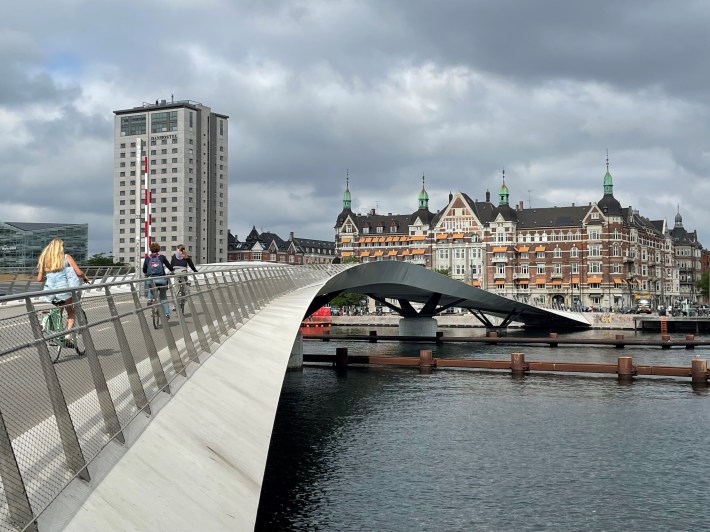
Photo: Rick Pruetz
DOT’s grant rescissions suggest that bikeways are an extravagant luxury — and European cities also have had to deal with similar falsehoods. In the 1980s and 1990s, Copenhagen fought naysayers who claimed the city could not afford world-class cycling infrastructure. As Colville-Andersen writes, this canard was easily disproved by the fact that for the cost of five to ten kilometers of an urban highway, an entire city can be served by an interconnected network of wide, separated, and protected cycle tracks that let people cycle wherever they want to go.
European genes do not produce some kind of innate affinity for human-powered mobility. People on any continent will use bike infrastructure if it is safe, extensively interconnected, reliable, maintained, and, most importantly provides a fast, inexpensive way to get their destinations.
The real concern is not that bikeway investments will not work in the U.S. More likely, the real fear is that European-class bike infrastructure could weaken the near monopoly that car and oil corporations have on mobility in the United States.

Read More:
Streetsblog has migrated to a new comment system. New commenters can register directly in the comments section of any article. Returning commenters: your previous comments and display name have been preserved, but you'll need to reclaim your account by clicking "Forgot your password?" on the sign-in form, entering your email, and following the verification link to set a new password — this is required because passwords could not be carried over during the migration. For questions, contact tips@streetsblog.org.