Talking Headways Podcast: The Lost Subways of North America
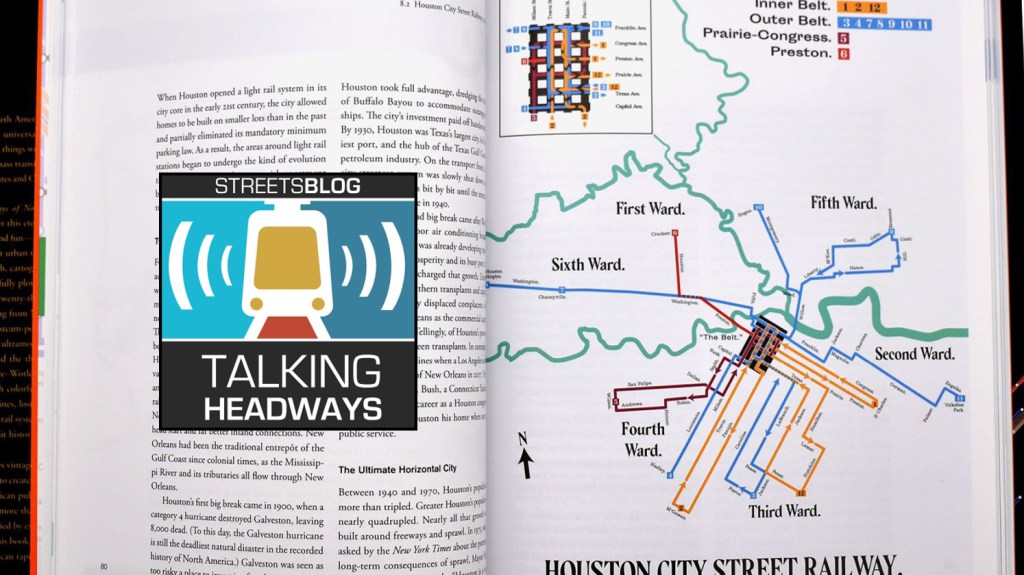
Sometime Streetsblog contributor Jake Berman joins the Talking Headways Podcast this week to talk about his book, The Lost Subways of North America: A Cartographic Guide to the Past, Present, and What Might Have Been. Berman and host Jeff Wood discuss transit histories through the lens of racial dynamics, monopolies, ballot measures and overlooked cities.
Scroll past the audio player below for a partial edited transcript of the episode — or click here for a full, AI-generated (and typo-ridden) readout.
Jeff Wood: I was also surprised at the density of Philadelphia’s streetcar lines from the past. I was looking at those maps. It feels like there’s a line on every street almost.
Jake Berman: Yeah, Philly’s system was built out by, I think it was close to 20 different streetcar companies, which ultimately fell under one monopoly, the Philadelphia Transit Co. And for various reasons, Philly ended up using streetcars for the bulk of its in city lines, and most of those lines that really should have been upgraded to carry some sort of subway surface route, like the ones that run to West Philly, just never were.
Jeff Wood: What’s interesting about Philly today, looking at those old maps?
Jake Berman: I think it’s interesting to me to see just the way that Philadelphia really used to be in competition with New York and Chicago for being one of the big three American cities. Philadelphia really does have that sort of legacy where they were, I think number four, number five, well into the 20th century, but for various reasons, they ended up getting lapped by D.C. and New York, and they don’t necessarily get treated as in the same league as D.C. and New York.
And I’m not sure whether that’s because they just happen to be smaller than the DMV slash the tri-state area, or it’s because Philadelphia is between DC and New York, whereas Boston on the other hand has a very different personality right? They don’t get overlooked nearly as much by, say, the national press in a way that Philly, Philly sometimes gets skipped if the analogy holds.
Jeff Wood: Why does Boston get attention in Philly get skipped?
Jake Berman: I think it’s a combination of the fact that Boston really doesn’t have any competition within New England. And the fact that so much of the American elite, for lack of a better word, goes to college at one of the many institutions in Boston that a lot of people pass through Boston in a way that they don’t pass through Philadelphia.
Jeff Wood: I guess that’s right. I hadn’t really been to Philadelphia until I went to a couple conferences there. But it’s interesting to go to a number of these different cities and see them from a planning perspective or a transportation perspective. But thinking about their history too is also fascinating.
I’ve been watching “The American Revolution” by Ken Burns and all these cities on the east coast get talked about and what’s fascinating now is to see how important they were then versus how important they are now. And then also listening to colleagues talk about places like Baltimore, where there’s a lot of folks who live in Baltimore and they’re talking about housing prices, etc., around the country, and they might not have the same perspective, and so they feel overlooked when we start talking about superstar cities and the housing crisis and things like that.
And it’s a little bit different in some of these other cities like Philadelphia or Baltimore. So I find that discussion interesting when we focus on these few cities. There’s others that could use a little bit of attention as well.
Jake Berman: I think that there is something to be said for places like Philly and Baltimore being somewhat overlooked because they did end up in some kind of post-industrial decline the way that say Buffalo or Detroit did in a way that didn’t really hit, say Boston or DC. Boston was never a major industrial center to begin with. Boston really peaked in the 1920s, and its population was largely stagnant and then began declining after the war.
Philadelphia and Baltimore hit their maximum population around 1950, if memory serves, and their decline was tied very deeply with the post-industrial era. Boston, unlike those two, had that massive educational cluster [and] that massive hospital cluster, that as it turns out became a really big deal when the economy became centered around things like healthcare and high-tech.
Philly has Penn and Temple and Baltimore has Hopkins, but it’s nothing like the cluster of Mass General, Harvard, BU, Boston College, MIT and all of the rest of the educational institutions in Greater Boston. So it’s not unfair to say that Boston is the world’s largest college town in a way that Philly and Baltimore use Penn and Hopkins as major economic engines, but they’re just one among many.

Read More:
Streetsblog has migrated to a new comment system. New commenters can register directly in the comments section of any article. Returning commenters: your previous comments and display name have been preserved, but you'll need to reclaim your account by clicking "Forgot your password?" on the sign-in form, entering your email, and following the verification link to set a new password — this is required because passwords could not be carried over during the migration. For questions, contact tips@streetsblog.org.