Confirmed: Non-Driving Infrastructure Creates ‘Induced Demand,’ Too
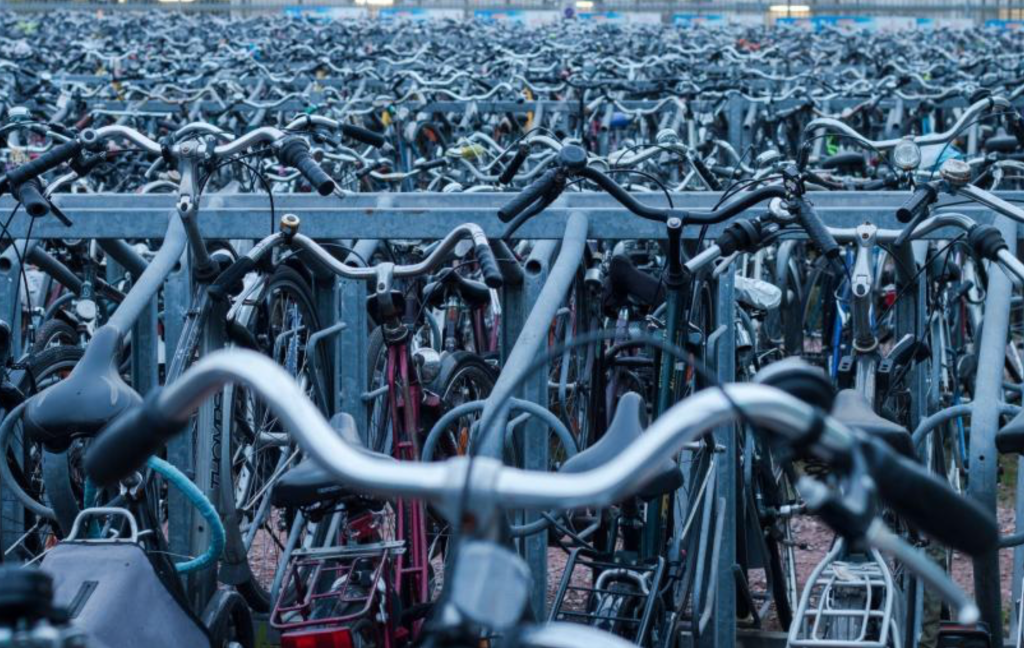
The phenomenon of “induced demand” doesn’t just apply to new highway lanes, a new study confirms — and if cities can pair great multimodal infrastructure with other actions that support people using it, it can be powerful force to decarbonize the transportation sector.
In what may be a global first, a team of researchers at the University of Cambridge in the United Kingdom finally put hard, country-wide data behind the intuitive idea that building multimodal infrastructure like bike lanes and rail lines will — surprise! — get more people biking, taking transit, and leaving their cars at home, at least in their home country.
Of course, there are already reams of data that prove building more car infrastructure results in more cars — even if a lot of transportation leaders and low-rent Batman villains have dismissed or ignored the phenomenon of included demand. But it’s comparatively hard to find aggregated evidence that the same is true for other modes, mostly because communities build so much less new bike, rail, and pedestrian infrastructure than they do roads for drivers, and collect so little data about how those changes affect ridership when they do.
Still, the researchers behind the study say their results help counter skeptics who argue no one uses their new multimodal infrastructure — and that those results can likely be replicated stateside. Though they also warn that policymakers shouldn’t assume that if they build it, non-drivers will invariably come, at least without promoting those modes in other ways.
“I do think that it is likely that there would be similar results for other countries, especially ones where there are similar can travel patterns to the UK,” said Hugh Thomas, the lead author of the paper. “However, we found even within the UK, there were differences between regions of the UK, and extrapolating it out might not be completely legitimate in all cases.”
Thomas explained that while induced demand is absolutely real across modalities, it’s also just one in a universe of factors that impact how people get around — and often, most of those factors urge travelers towards driving.
When a driver takes a newly built highway lane, after all, that decision isn’t just motivated by a desire for a slightly faster commute on some fresh asphalt — which that driver herself quickly undermines as she and all the other drivers quickly form a traffic jam. It’s also fueled by public attitudes that stigmatize and even criminalize other ways of getting around, subsidies that make motoring artificially cheap, and a raft of non-infrastructural policies that make taking another modes inconvenient, dangerous, or outright impossible.
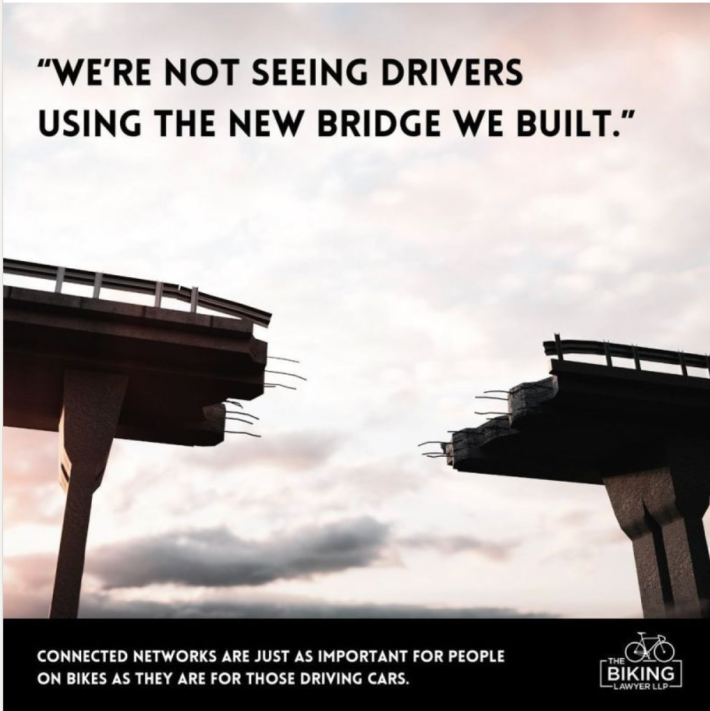
The decision to not use multimodal infrastructure is influenced by all those factors, too — as well as ones drivers rarely face, like bike lanes that abruptly end and strand them in traffic.
Put it all together, and the study found that if the UK stayed on its current transportation trajectory, it could reduce the energy consumed by the transportation sector, while still allowing for increases in population and overall mobility — but energy demand would still rise 9 percent by 2060, not far below a 12-percent projected increase in overall travel.
“It isn’t that much,” Thomas admits. “But what I think is important is that this is complimentary to all the other kinds of tools in the arsenal that we’ve got to decarbonize. This is complementary to electrification of cars and other passenger transport; this is complementary to fuel switching. It can be applied on top of that.”
Perhaps more controversially in the country that was the birthplace of the anti-15-minute city conspiracy, Thomas says that mobility reduction can also be a crucial tool to decarbonize transportation — though in reality, that so-called “reduction” actually adds convenience to residents’ lives as destinations sprout up right in their neighborhoods, rather than being forced to schlep more than 15 minutes away just to meet their basic needs. Work-from-home policies, similarly, can subtract all kinds of travelers from the road, but multiplies the time, joy, and ease with which many of them experience the workday, among a host of other individual and societal benefits.
Best of all, shorter travel distances are often a natural byproduct of the good kind of induced demand: the kind that induces people to get out of their cars. But first, policymakers have to embrace a new, holistic vision for transportation, and stop building senseless roads.
“Of course, one of the main levers that we have to try and influence mode shift is through infrastructure,” Thomas added. “And so then the question is: what infrastructure do we need?”

Read More:
Streetsblog has migrated to a new comment system. New commenters can register directly in the comments section of any article. Returning commenters: your previous comments and display name have been preserved, but you'll need to reclaim your account by clicking "Forgot your password?" on the sign-in form, entering your email, and following the verification link to set a new password — this is required because passwords could not be carried over during the migration. For questions, contact tips@streetsblog.org.