Talking Headways Podcast: Reclaiming the Road
This week we’re joined by Oxford, Ohio, City Councilor and Miami University of Ohio geography professor David Prytherch.
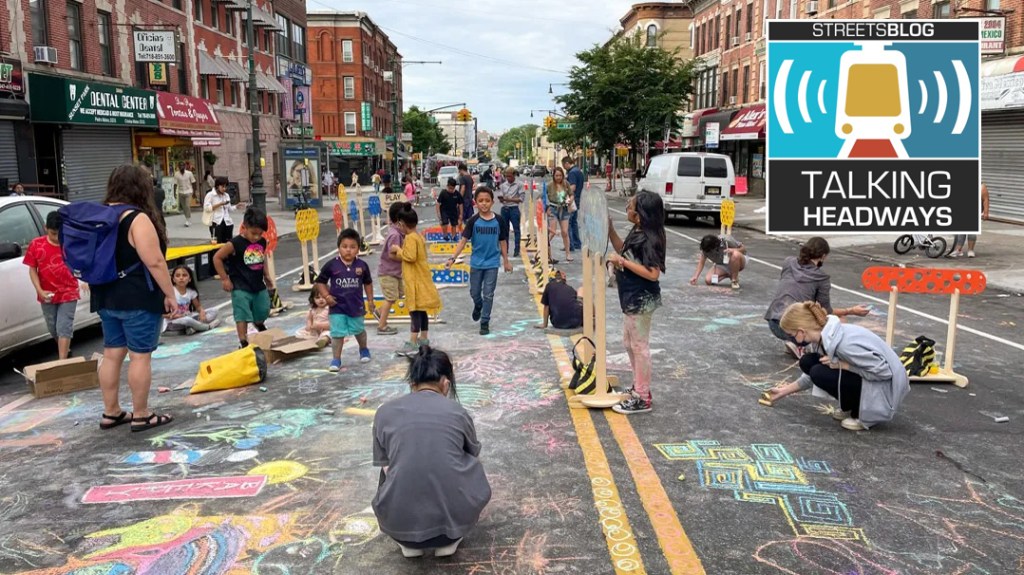
We did Prytherch’s new book Reclaiming the Road: Mobility Justice Beyond Complete Streets. The conversation touches on how pandemic open street experiments were rediscovering original uses, the cognitive benefits of experiencing car free streets and the opening of a democratic space for a discussion of what streets could and should be.
Scroll past the audio player below for a partial edited transcript of the episode — or click here for a full, AI-generated (and typo-ridden) readout.
Jeff Wood: And one of the things that stood out to me from reading was just, like, this idea that streets aren’t just a physical space. They’re actually social constructs as well, right? Like, we engineer them for traffic flow, but when we do that, what are we taking away? And so what does this look like? Like a hundred years ago before the cars were here, was it more equal? You know, there obviously were racial differences, like people’s opinions about what should be in the street, commerce, etc. And so, you know, looking back in time before the car, which makes our job a whole lot of a mess now, where do we stand even before cars came to bother us on our streets?
David Prytherch: I think what’s so interesting, and part of my project has been, and this is where the, you know, the Peter Nortons of the world have been so helpful in helping us understand what happened to streets a hundred years ago.
They went from being social spaces that were relatively lightly regulated because they were understood to be public and there were some norms, but it was the introduction of the automobile that led to a very codified rule-based engineering of the space where it became infrastructure and in becoming a highly engineered infrastructure, it wasn’t just about that the street got paved and striped and all those sorts of things.
Infrastructure is one of those things that, kind of dispersively, we take out of the category of being social. As I was working with the last book, once you start thinking of the street as, like, a conduit for cars, you place a different set of expectations from the street that tend then to be technical. And so what’s so powerful to me about what’s happened in recent years is a kind of lowering of the veil, which is, okay, the street, yeah, it is infrastructure, but it is and always has been a public space. And so to look back at how did people share the street space 120 years ago — those norms have been forgotten ’cause they’re subsumed under this whole edifice of traffic engineering.
But this is what the experiment of, for example, open streets — cities had to kind of rediscover, like, how do you juggle this stuff in what’s ultimately a very amorphous space — the street as we engineer it. Okay. There’s a lane for cars and another lane for cars and a bike lane, and everybody’s got their space and it’s orderly.
The minute you kind of create, it’s pedestrianized, but we’re still letting bicycles through and maybe we’re letting slow cars through. It’s probably not labeled and marked and divided and chopped up. It’s then it’s organically shared space. It’s really messy. And that’s what I think cities have been trying to struggle with is to relearn what some of that sharing was like from a social point of view that cannot be captured in signs and markings and statutes.
Jeff Wood: From, like, a neuroscience perspective, it’s also interesting because people’s brains basically break when you start to put in some of this chaos, uh, or some of the perceived chaos, I should say, of putting in a bike in a place where people usually walk or anything that might not be, and ’cause they understand cars go here and pedestrians and everybody else go here.
But then when you start mixing even more. It’s like people complain more about whether they’re, gonna get run over by an e-bike than the tens of thousands of people that are killed by cars every year. Right? So it’s like this interesting neurological change in people’s minds, and they can’t quite put their heads around it because it doesn’t make sense along the lines that they’re used to.
David Prytherch: It’s really a powerful thing, and this is why I think that some of the stuff that I was studying in the book and the whole range of ways that cities are reclaiming streets, but even those events that are ephemeral, you know, one of the things that really paved the way for this a lot was the open streets, free streets, summer streets, which you close off streets for a weekend.
They were ephemeral events, but there’s something probably, and I’m not a neuroscientist, but cognitively powerful about walking down the middle of the street. That used to be the domain of the car and experiencing it as something different. And so even though planners, for example, recognized that some of these interventions were not a full reclaiming of the street. I think they saw there was a lot of cognitive benefit to stepping off the curb and sharing the space in a new way.
And yeah, I wouldn’t be surprised if there are neural pathways that need to form in order to be able to deal with that. But it’s only by doing it that you can then see the world in a different way and then figure out how can I live with the e-bikes and the restaurant sheds and the delivery trucks?
Sharing the city and its spaces is really hard. But, we do it in other places. We’ve always had parks that were shared spaces and we expect them to be somewhat messy and organic and the street, I think we can learn to see it in that way also.
Streetsblog has migrated to a new comment system. New commenters can register directly in the comments section of any article. Returning commenters: your previous comments and display name have been preserved, but you'll need to reclaim your account by clicking "Forgot your password?" on the sign-in form, entering your email, and following the verification link to set a new password — this is required because passwords could not be carried over during the migration. For questions, contact tips@streetsblog.org.