Survey: Americans Still Want Police To Cut Traffic Stops That Don’t Make Anyone Safer
Most U.S. voters support ending the kind of low-level traffic stops that are most likely to harm Black and brown road users without making streets meaningfully safer, a new survey suggests — evidence that communities could strike those laws from the books and redirect resources to stopping much deadlier roadway crimes.
A whopping 59 percent of registered voters say they either strongly or somewhat support “a law eliminating non-safety-related traffic stops,
while keeping traffic stops for serious safety risks such as reckless driving or excessive speeding,” according to a YouGov survey commissioned by Vera Action, the advocacy arm of the Vera Institute of Justice.
Those “non-safety-related stops,” experts explain, include infractions like broken tail lights, air fresheners dangling from mirrors that might block a few inches of a driver’s view, and “jaywalking” laws, all of which, proponents claim, could theoretically make people safer on the roads under certain crash conditions.
In practice, though, opponents say those stops siphon resources away from efforts to stop speeders and other motorists who are actively endangering themselves and others — and that they’re often used as pretexts for police to conduct searches, with road users of color bearing the brunt of the stops.
Those searches, meanwhile, rarely result in the recovery of guns or other contraband, but do often result in physical, psychological, and economic harm to road users whose only crime was a minor code violation, or not being able to afford to buy a helmet or register a car in an autocentric city that functionally requires them to drive one.
“The purpose is to promote fairness, to increase opportunities, to strengthen trust with government generally law enforcement in this context,” said Daniela Gilbert, who directs Vera’s Redefining Public Safety initiative. “[It’s about] prioritizing limited public resources for activities that are more likely to put the public at risk.”
Gilbert acknowledges that eliminating non-safety stops can be politically challenging, even as she argues that there’s solid proof doing it can improve safety outcomes and restore public trust in police.
Fayetteville, N.C. made the reform in 2013, but reversed course in 2017, despite the fact that eliminating low-level traffic stops led to decreased racial disparities in traffic enforcement — as well as decreased car crashes, injuries, and fatalities — with no impact on the non-traffic related crimes that some police argued more vehicle searches could help prevent.
Some street safety advocates, meanwhile, have been hesitant to throw their energy behind reforming non-safety stops if it simply means redirecting resources to over-policing other crimes, which they would rather see cities tackle with infrastructure, vehicle safety technology, and other systemic interventions, rather than officers with badges and guns alone.
Gilbert argues, though, that real people getting hurt by non-safety-related stops right now — and the time to get rid of them is overdue.
“This is not at all intended to be a substitute for the very necessary structural and systemic changes. … [It’s] really about [leveraging] the existing investments in law enforcement in our country, and the resources of time and people power,” clarified Gilbert. “Opportunities to improve vehicle design, to invest in improvements in transit, and other infrastructure-related changes are critical. This is in no way intended to supplant case making for those changes, which we also support.”
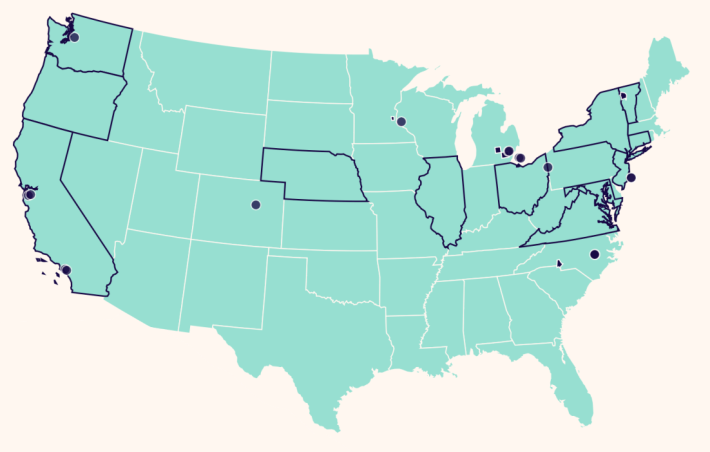
Dozens of U.S. communities already seem to have bought into that message.
Alongside the survey, the Vera team released a new map of cities, counties, and even whole states across America that are either considering or have already passed policies eliminating at least one category of non-safety related stops, in hopes of inspiring communities not on that list to follow their example. They’re also offering a packet of resources to help them speed the process of instituting reforms, including collecting data that demonstrates the need for better policy and navigating which level of government is best equipped to make changes.
And with an “anti-DEI” federal government poised to more widely transform state and local law enforcement into an arm of its federal deportation efforts, there may be no more urgent time to make those changes than now — especially since many of those deportations begin with exactly these kinds of low-level traffic stops.
“The number of policies that have been enacted is more than a handful,” added Gilbert. “[We have the] opportunity to continue to make progress on reducing our over-reliance on law enforcement for actions that are not a great use of their time, and that are not actually in the interest of public safety. And a lot of action can still be taken at the state and local level in that domain, regardless of the federal government’s point of view.”
As America enters an uncertain new era and the protests that followed the deaths of Michael Brown and George Floyd fade from the headlines, Gilbert says these survey results show that Americans still want more justice and safety on their roads — and that their leaders need to listen to them.
“We really want to guard against the possibility of hopelessness and concern around losing momentum or being unable to advance sensible public safety system change,” she added. “We want people to know that improvement is possible.”

Read More:
Streetsblog has migrated to a new comment system. New commenters can register directly in the comments section of any article. Returning commenters: your previous comments and display name have been preserved, but you'll need to reclaim your account by clicking "Forgot your password?" on the sign-in form, entering your email, and following the verification link to set a new password — this is required because passwords could not be carried over during the migration. For questions, contact tips@streetsblog.org.