Skip to Content
Streetsblog USA home
Log In
Bicycling

Epic 150-Kid ‘Bike Bus’ Shows America a Better Way to Get to School

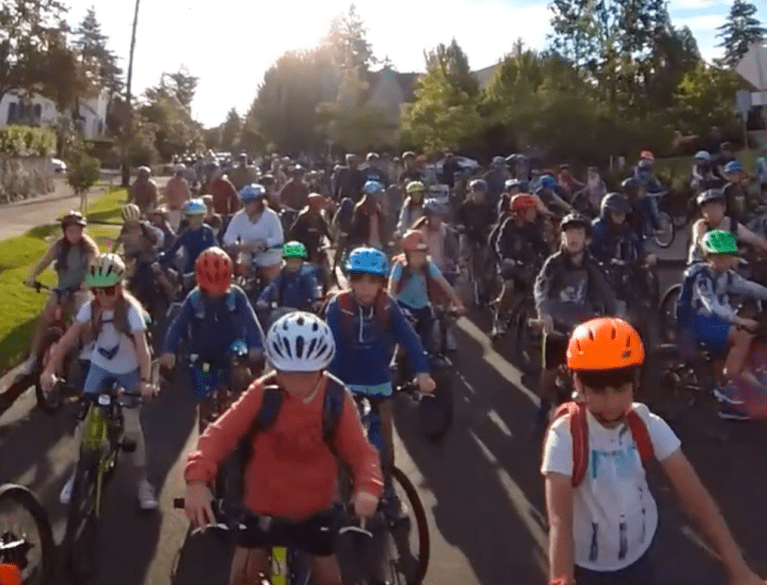
Photo: Sam Balto

A viral video of hundreds of students biking to school together shows how to give more kids the opportunity to get to school on their own two wheels.

On Thursday, friend of Streetsblog and Portland public school teacher Sam Balto wowed Twitter with his video of a "Bike Bus" event he'd organized, which brought together roughly 150 young riders to keep each other safe on their shared journey to Alameda Elementary in the Oregon metropolis. Though they're growing increasingly popular in countries around the world, Bike Buses are still relatively rare in the U.S., and usually involve only a small group of riders, rather than enough youngsters to fill a modest commercial jet.

Balto says this adorable junior version of a Critical Mass ride attracted a stunning 27 percent of the school's student population, and that other kids may have ridden to school separately, too. By contrast, only 10 percent of all U.S. kids either biked or walked to school in 2009, the last year for which data is available — and given the increasingly child-hostile megacars that have saturated U.S. roads since then, the number is likely even lower now.

Balto credits much of the impressive turnout for his Bike Bus to the magic of biking itself, though his and his colleagues' dedicated work deserves a hat tip, too. The event happens every Wednesday, and school staff regularly follows up with families to make sure the event is inclusive and they know how to participate.

"I think students and families are showing up in such numbers because biking with friends is fun and enjoy the freedom bikes provide," he said. "Parents love seeing their children being a part of the school community."

Balto emphasizes Bike Buses don't need to be large, and that even just a few families can easily start a kiddie convoy of their own by creating a simple route and a list of meet-up times on a shared email chain or Google Drive. Though for those efforts to really take off, policymakers should get involve, too — particularly when it comes to addressing the structural reasons why more kids don't already bike or walk to school, like dangerous roads and vehicles.

"City and state leaders they should create and fund Active Transportation to School programs that pay parents, school staff and members of the community to provide services like Bike Buses and Walking School Buses," Balto adds. "The health, environmental, social and academic benefits of active transportation for children are well researched, and the time is now to invest in helping our getting to school in an active and fun way."

Stay in touch

Sign up for our free newsletter

More from Streetsblog USA

Wednesday’s Headlines Don’t Got a Fast Car

If Tracy Chapman had saved "just a little bit of money" these days, she'd be in trouble.

March 4, 2026

Dear Trump: the Future Belongs to the Efficient

Trump abandoned climate protection goals claiming that cheap fossil fuel helps consumers and the economy. A mobility-focused analysis shows that he is wrong: resource efficiency is the key to health, economic success and happiness.

March 4, 2026

Tuesday’s Headlines Are a Little Bit Safer

Traffic deaths are down about 12 percent, which the National Safety Council attributes to new technology and infrastructure investments.

March 3, 2026

Could Refurbished E-Bikes Be the Secret Weapon of the Livable Streets Movement?

A high-quality used market could be the boost America needs to get would-be riders off the sidelines and into the saddle, a new report argues.

March 3, 2026

How the ‘Little Free Pantry’ Can Help Feed the Hungry Without Requiring Them to Drive

Researchers are trying to reduce the mobility barrier to food by bringing it directly to neighborhoods.

March 3, 2026

Exactly How Much It Cost to Build the Average Parking Space In Your City

For new apartments, the research found that building required parking adds roughly $50,000 to $100,000 per unit, and disproportionately increases the cost to build smaller apartments.

March 2, 2026
See all posts