Study Discovers High Levels of Air Pollution on Boston’s Subway Platforms

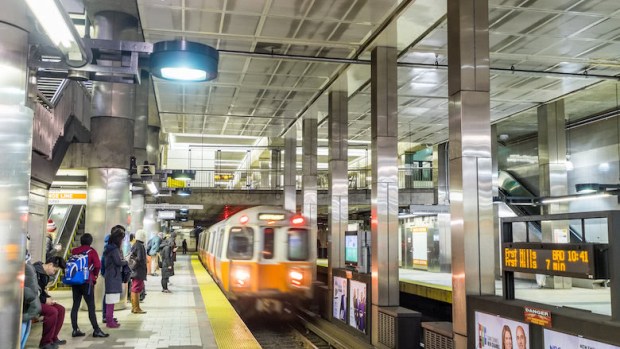
Here’s one more good reason to wear a mask on the T: new scientific research has discovered unhealthy levels of air pollution on subway platforms in Boston and New York City.
During the summer of 2019, researchers from the NYU Grossman School of Medicine measured air samples in 71 stations during the morning and evening rush hours in Boston, New York City, Philadelphia, and Washington, D.C. Their findings were published on Wednesday in the journal Environmental Health Perspectives.
While New York’s subway stations had the dirtiest air, the study team found that the concentration of airborne pollutants on underground train platforms in Boston still reached levels that raise concerns for riders and for transit employees who spend long periods of their day underground.
The study team found that the average level of fine particulate pollution on Boston’s underground subway platforms was 139.8 micrograms per cubic meter – a level of pollution that’s categorized as “unhealthy” under the EPA’s air quality index.
Air quality measurements at above-ground stations, on the other hand, were found to be comparable to the ambient levels of air pollution on surrounding streets.
“Our findings add to evidence that subways expose millions of commuters and transit employees to air pollutants at levels known to pose serious health risks over time,” said the study’s lead author David Luglio, a doctoral student at NYU Grossman, in a press statement accompanying the research paper.
Among the MBTA stations that were analyzed, the study team found the dirtiest air samples on the Broadway station on the Red Line. More detailed analysis found that the primary source of pollution seems to be iron dust generated from train wheels and rails, as well as from wear and tear from trains’ collector shoes that brush against the third rail. Dust from decaying organic matter was another major component of underground pollution.
Notably, the study only measured air quality on the rapid transit network, not on commuter rail platforms, where diesel exhaust from trains could generate even higher levels of hazardous pollution.
The authors plan to do additional research into why why some subway systems, like Philadelphia’s, are less polluted than others, and to recommend practices that could improve air quality relatively quickly.
The MTBA is in the midst of a major project to upgrade ventilation and improve air quality at the Back Bay station, where passengers can often smell the exhaust from diesel commuter rail trains. Streetsblog has reached out to the agency to comment on this research; this story will be updated if and when they respond.

Read More:
Streetsblog has migrated to a new comment system. New commenters can register directly in the comments section of any article. Returning commenters: your previous comments and display name have been preserved, but you'll need to reclaim your account by clicking "Forgot your password?" on the sign-in form, entering your email, and following the verification link to set a new password — this is required because passwords could not be carried over during the migration. For questions, contact tips@streetsblog.org.