Cyclists Take Over D.C. Streets to Demand Safety
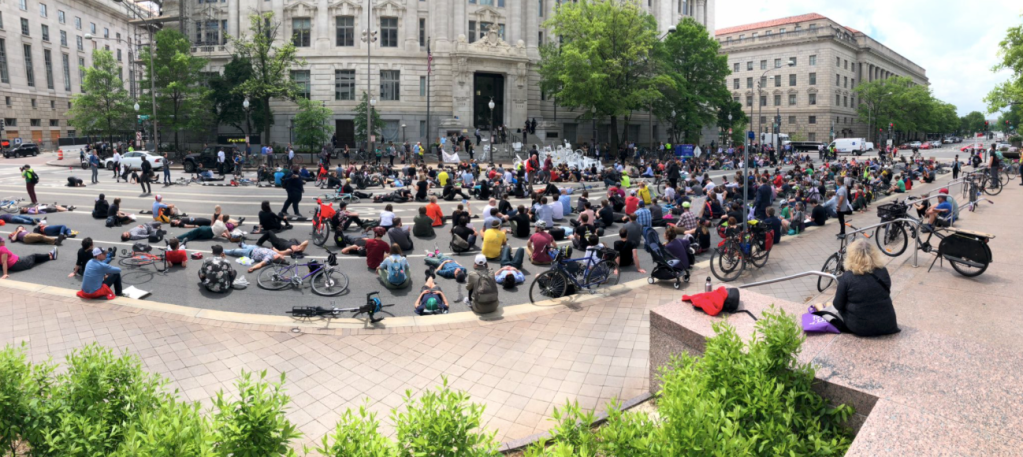
Cyclists in D.C. are fed up with their friends getting killed.
On Friday, hundreds of people who get around by bicycle marched on City Hall, and spilled into the streets nearby, in a powerful protest of the Bowser Administration’s lack of action.
The “Rally for Streets that Don’t Kill People” comes one week after the death of well-known bike activist Dave Salovesh, who was killed by the driver of a stolen van on a street without a protected bike lane. Later in the weekend, Abdul Seck, a pedestrian who was visiting the city, was killed by a speeding driver.
“One loss of life at the hands of a driver in one weekend is too many, but two is too much,” said Rachel Maisler, chairwoman of the D.C. Bicyclist Advisory Council, who organized the event. “We’ve been mad. We’re more mad.”
Cyclists laid down in the street, and activists read aloud the names of 128 people who have been killed on D.C. roads since Mayor Muriel Bowser took office in 2015. Last year’s 36 fatalities were about 44 percent higher than in 2010. That death rate is more than double that of New York, a city of 8.5 million where 202 people died in road violence last year.
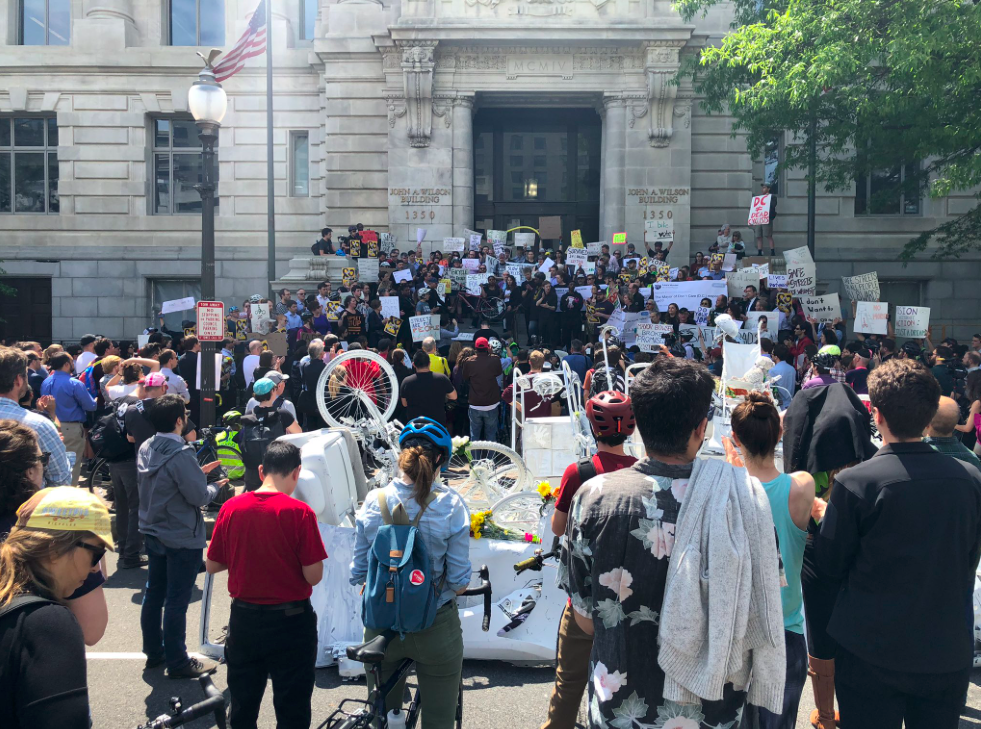
Someone constructed a giant white sculpture out of bikes and car parts, as a memorial to those killed. Sherri Joyner, who was hit by a driver from behind riding her bike in 2018, spoke about the need for progress.
Other activists in D.C. participated in the nationwide #RedCupProject protest on Friday to remind city officials that painted bike lanes offer about as much protection as a disposable frat house beer cup or a tomato.
The city has technically committed to Vision Zero, but advocates say City Hall has not been living up to the rhetoric under Bowser.
“You’re not seeing DDOT really do anything that looks like Vision Zero in a measurable fashion,” Greater Greater Washington’s Alex Baca told Streetsblog last year. Since then, said Maisler, nothing much has changed.
Streetsblog reached out to the Mayor’s office for comment and will update the story if the city gets back to us.