The Environmentalist Blind Spot on Transportation
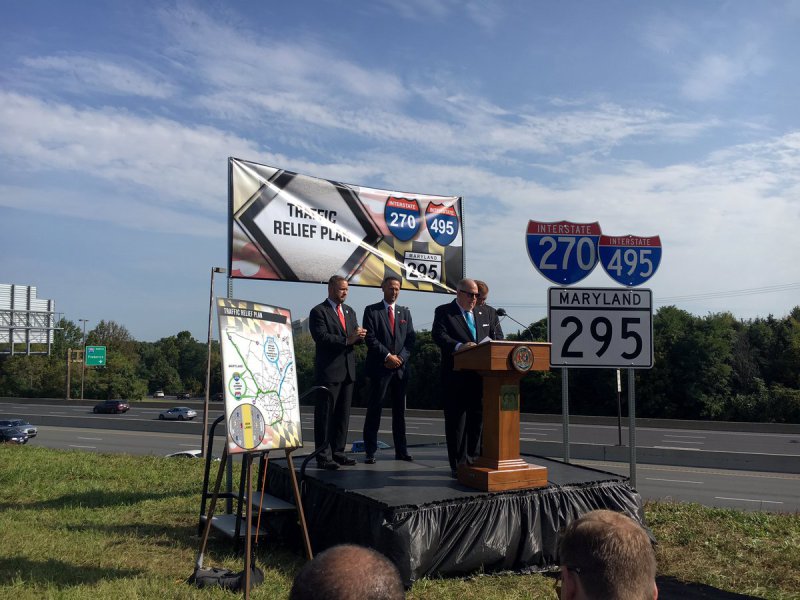
Maryland Governor Larry Hogan is the last person environmentalists should be cheering for.
Since taking office, Hogan has unilaterally killed Baltimore’s much-needed Red Line light rail and a major mixed-use, transit-oriented development project in the city, while diverting transportation funds to highways and proposing a massive suburban toll road expansion. Under his watch, Baltimore’s sole metro line reached such a state of decrepitude that it had to be closed for a month of emergency repairs.
Nevertheless, in this week’s Baltimore Sun, Ramon Palencia-Calvo of the Maryland League of Conservation Voters praised Hogan’s “recent commitment to developing a cleaner transportation system.”
What leads Palencia-Calvo to gloss over Hogan’s massive, sprawl-inducing, carbon-burning highway expansion plan is that “Maryland could soon have the second largest EV charging network in the country, with 24,000 charging stations.”
The Maryland League of Conversation Voters is hardly the only environmental group that meekly accepts the climate damage caused by car-centric sprawl while putting all of its “clean transportation” eggs in the electric vehicle basket.
In California, local chapters of the Sierra Club are notorious for opposing urban infill housing. Last year, the San Francisco Sierra Club fought a 66-unit apartment building that would replace an “historic” parking garage. The California Sierra Club has come out against SB827, a state bill that would enable the construction of more housing in locations with good transit. While there are legitimate concerns about how the bill may affect housing markets in low-income communities, the Sierra Club simply urged the bill to be withdrawn, instead of proposing amendments.
Many national environmental organizations have better track records. The Natural Resources Defense Council, for example, has been instrumental in pushing federal-level transportation policy reforms. The national Sierra Club supports smart growth.
But the national climate movement can also be incredibly naive and tone-deaf when it comes to local policy. Recently, the Bill McKibben-led 350.org put New York City Mayor Bill de Blasio on a pedestal for making the politically risk-free decision to divest city pension funds from the fossil fuel industry and sue oil companies for climate change-induced damages. McKibben wrote that de Blasio’s theatrical announcement “means the tide is finally turning in the climate fight.”
Meanwhile, de Blasio’s climate record on local policy leaves a lot to be desired. He’s failed to accelerate bus priority improvements while bus ridership has plummeted. He’s antagonized delivery workers who use e-bikes, handed out tens of thousands of free parking perks to city employees, and declined to support congestion pricing. There’s nothing risky, daring, or envelope-pushing about de Blasio’s sustainable transportation policies. He basically does whatever is politically convenient.
The episode says a lot about the limited perspective of many environmental organizations on transportation policy and carbon emissions. The premise underlying much of McKibben’s work is that the climate movement needs to be energized by high-profile campaigns like divestment and stopping pipelines. Those are fights worth waging. But that momentum has to translate into campaigns to stop highways and build places where walking, biking, and transit are the most convenient modes of transportation. Otherwise, we’ll keep on burning carbon in subdivisions filled with large lot homes where driving is the only way to get around.

Read More:
Streetsblog has migrated to a new comment system. New commenters can register directly in the comments section of any article. Returning commenters: your previous comments and display name have been preserved, but you'll need to reclaim your account by clicking "Forgot your password?" on the sign-in form, entering your email, and following the verification link to set a new password — this is required because passwords could not be carried over during the migration. For questions, contact tips@streetsblog.org.