DC Gives New Dockless Bike-Share Services a Trial Run
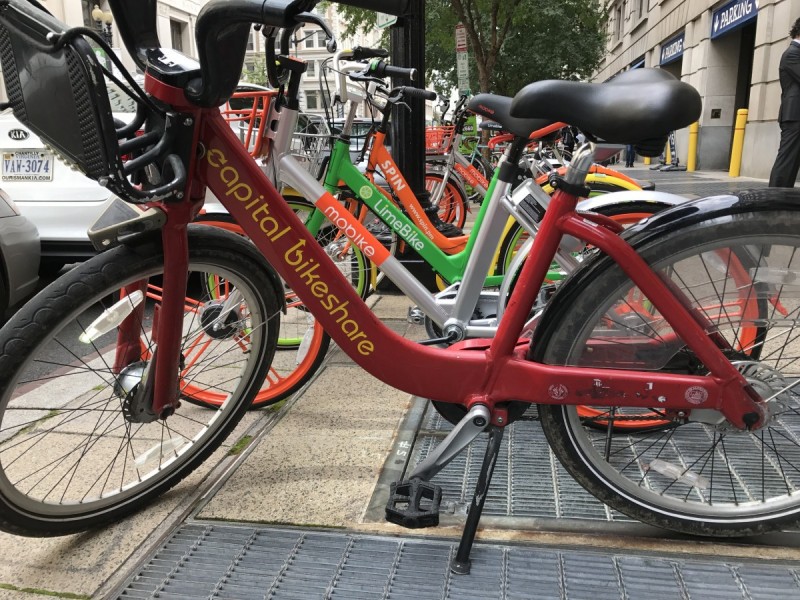
In Seattle, the arrival of venture-financed dockless bike-share fleets this summer filled a vacuum. An earlier, publicly run bike-share system had flopped, and the new bike-share companies were starting with a blank slate. But what about cities that already have established bike-share systems — can new companies complement existing bike-share options in a way that improves service for the public?
One city in search of an answer is Washington, DC. Last week, three dockless bike-share start-ups — Mobike, LimeBike, and Spin — launched pilot programs with the city’s blessing, each putting out a few hundred bikes. A fourth company, Jump, which provides electric-assist bikes, debuted its service yesterday.
City officials told the Washington Post they want to see how the new companies can fill gaps in the Capital Bikeshare service area and increase bike-share capacity during peak periods when the current system gets overwhelmed. The city will use the trial period to develop rules for long-term permits for the new companies, according to the Post.
It’s too early to answer the big questions about how the new services will change bike-share in the city, but DC residents have had a few days to try out their offerings. David Alpert at Greater Greater Washington has been test riding the bikes and comparing the companies’ pricing models:
- Pricing: Mobike, LimeBike, and Spin all offer 30-minute rides for $1. Mobike and LimeBike (use code HELLODC for LimeBike) are offering free rides until the end of September. Single rides on Capital Bikeshare are $2 (though single rides make up less of CaBi’s business model). Mobike requires you to put in some money (at least $1) to start using the app (and you have to put $1 on to get the free rides). LimeBike lets you sign up and take a free ride (even after September) without entering any credit card information, and Spin requires a credit card but you don’t have to pre-pay. Mobike and LimeBike offer discounts if you put more money on the account: for $5 you also get a free ride; $10, it’s three free rides, and for $20, six.
- Memberships: Besides the single-ride charge, LimeBike and Spin offer monthly memberships for $29-$30 a month. (Compare that to Capital Bikeshare’s $85 annual membership; $30 a month comes to $360 a year or over four times the price.) Mobike doesn’t have memberships, but it has a “points” system where you earn points for taking rides, reporting broken bikes or bikes parked in bad spots, or inviting other people. But if you do bad things like “abandoning the bike when intercepted by police,” you lose points. The wording suggests you can get cheaper rides if you have a higher score, but it doesn’t specify if that’s happening now or what discount you get.
Alpert’s full review is worth a read if you’re interested in the differences between each company’s bikes and apps, and he also posted a separate overview of Jump’s bike-share service (the electric assist “makes riding up a steep hill quite easy,” he says).
Other cities will definitely be keeping an eye on DC’s experiment to see how the new services can be integrated into the existing bike-share ecosystem and advance the goal of increasing access to cycling.
More recommended reading today: streets.mn looks at how anti-harassment ordinances can empower cyclists. And Seattle Transit Blog reports that a new red bus lane will speed trips for riders on Metro’s Route 8.

Read More:
Streetsblog has migrated to a new comment system. New commenters can register directly in the comments section of any article. Returning commenters: your previous comments and display name have been preserved, but you'll need to reclaim your account by clicking "Forgot your password?" on the sign-in form, entering your email, and following the verification link to set a new password — this is required because passwords could not be carried over during the migration. For questions, contact tips@streetsblog.org.