Seattle DOT Hits the Street to Tell People About a New Bike Lane Proposal


Michael Andersen blogs for The Green Lane Project, a PeopleForBikes program that helps U.S. cities build better bike lanes to create low-stress streets.
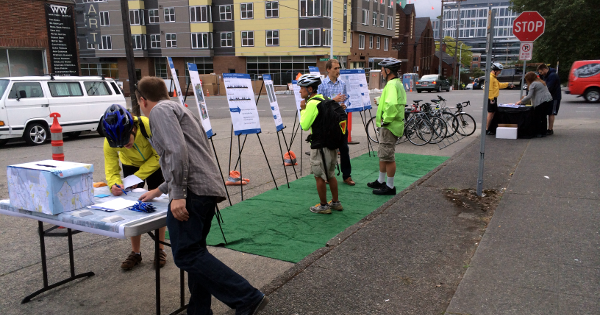
One part public outreach and one part PARK(ing) Day, Seattle DOT held a three-hour open house last Wednesday for a half-mile protected bike lane on Dexter Avenue. The outreach session took place on green plastic mats spread out to cover an empty parking space.
Project manager Kyle Rowe explained that a different, state-led project on Dexter had him on a tight deadline. What’s more, because Dexter is a necessary link between downtown and the heart of Seattle’s bike culture in Fremont and Ballard, the number of affected households was huge.
“That is kind of like a funnel for roughly two-thirds of north Seattle,” Rowe said. “To capture all the people that use Dexter in a traditional open-house style, which would be 7 to 8 or 9 p.m., would mean flyering or sending a mailer out to most of North Seattle, and that didn’t make sense. I also wanted to accelerate this to meet the deadline of the state’s restoration work.”
So Rowe used a trick he said he’d seen on “Streetblog or CityLab” and held his public meeting on the side of the street from 7 to 10 a.m. on a weekday. He brought eight easels, two tables, a few temporary bike racks, a comment box, sticky notes, a sign-in sheet and a bunch of hot coffee.
That last item was important.
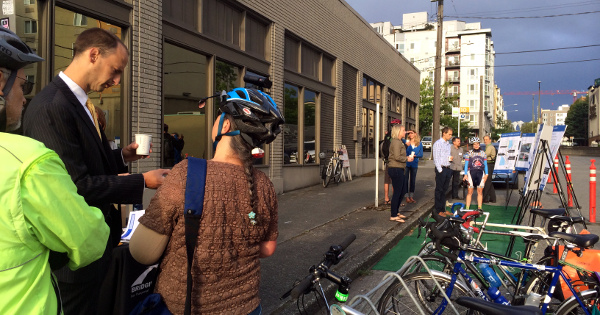
“I think the coffee was the big sell, but it definitely allowed us to get five minutes with them,” he said.
The open house drew 40 to 60 people, Rowe estimated: people passing by, working or just walking in the area. It cost exactly as much in staff time as a traditional evening open house. And unlike an indoor meeting space, the street use permit was free.
Rowe said almost all the responses were positive, though some people had requests for changes to crosswalks.
New Seattle Transportation Director Scott Kubly stopped by, arriving on his own bike. So did more than one local TV station, but Rowe said he doesn’t think the TV stations ever broadcast anything.
“Maybe there wasn’t enough controversy,” he said.
You can follow The Green Lane Project on Twitter or Facebook or sign up for its weekly news digest about protected bike lanes.

Read More:
Streetsblog has migrated to a new comment system. New commenters can register directly in the comments section of any article. Returning commenters: your previous comments and display name have been preserved, but you'll need to reclaim your account by clicking "Forgot your password?" on the sign-in form, entering your email, and following the verification link to set a new password — this is required because passwords could not be carried over during the migration. For questions, contact tips@streetsblog.org.