DUI Arrests Dropped in Philly After Ride-Share Companies Came to Town
There’s a big political battle in Pittsburgh over the introduction of ride-sharing businesses like Uber and Lyft.
Pittsburgh’s progressive new mayor, Bill Peduto, has been a strong proponent of the services, which allow users to buy rides from drivers using a cell phone app. But the Pennsylvania Utilities Commission, the agency responsible for regulating taxis, recently issued an order preventing the companies from operating. Now the issue is being debated in the statehouse.
Meanwhile, Jon Geeting at Plan Philly reports some interesting new information has come to light showing a possible safety effect of the introduction of ride-sharing services in 2012 in Philadelphia, where the taxi industry is not under the purview of the state Utilities Commission:
This issue raises some legitimately challenging questions about safety and liability, but to date there hasn’t been much discussion about the safety implications of not allowing these apps.
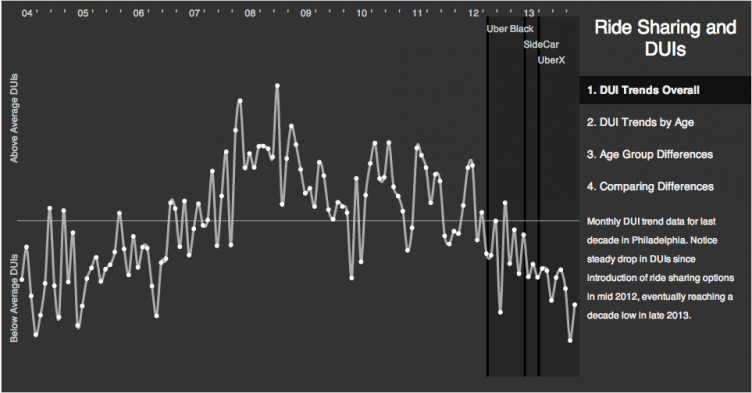
Pittsburgh-based computer science professional Nate Good has been trying to move this debate forward in his city, and he released a few infographics he made about ride-sharing and DUI arrests in Philly (where, unlike Pittsburgh, the companies have been around long enough to draw some conclusions about their impact.) What he found is that there’s a correlation between ride-sharing services coming on the market and a reduction in DUI arrests, particularly for the under-30 demographic that uses them the most.
Good says:
After all ride sharing services were in effect (April 2013 through the end of 2013), the average number of DUIs per month dropped across the board by 11%, with those under 30 being mostly responsible for the drop:
- Overall: 1121.9 (11.1% decrease)
- Under 30: 450.9 (18.5% decrease)
- Over 30: 671 (5.3% decrease)
Of course, DUI arrests were trending downward before the ride-share companies launched in Philly. While this data may not prove that ride sharing caused a decrease in drunk driving, it is a plausible conclusion. Let’s hope the state’s regulators are willing to consider this data.
Elsewhere on the Network today: Urban Velo reports that a cyclist in Orange County is being charged by police after recording a video of drivers throwing objects at him. Urban Cincy says that the city’s low score on walkable urban destinations in a recent study shows the city is poorly situated for the future. And Systemic Failure considers the return on investment from the $1 billion the United States Department of Homeland Security has poured into American transit systems.

Read More:
Streetsblog has migrated to a new comment system. New commenters can register directly in the comments section of any article. Returning commenters: your previous comments and display name have been preserved, but you'll need to reclaim your account by clicking "Forgot your password?" on the sign-in form, entering your email, and following the verification link to set a new password — this is required because passwords could not be carried over during the migration. For questions, contact tips@streetsblog.org.