A Golden Opportunity for Congress to Avoid the Transportation “Fiscal Cliff”

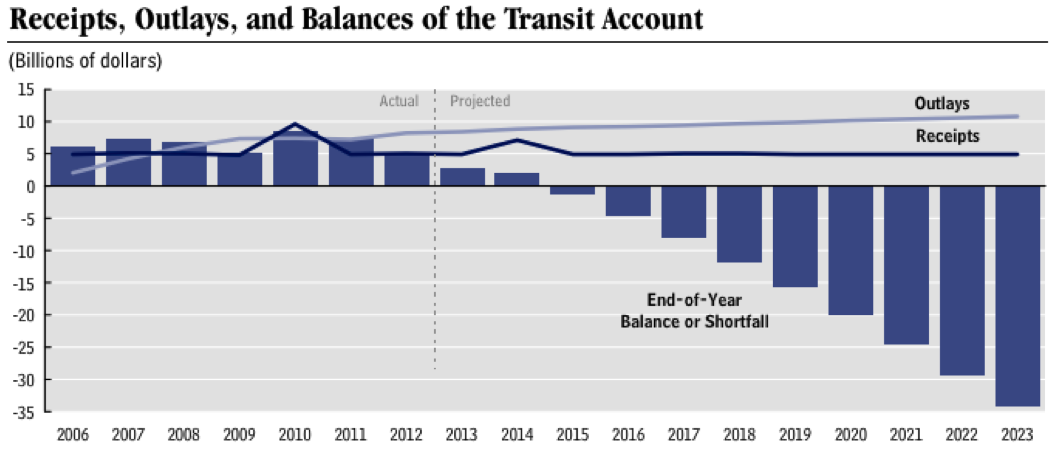
MAP-21 expires in a year and five months. When it does, if lawmakers haven’t already found a solution to the “transportation fiscal cliff,” they’ll have to do one of three things, according to a report issued last week by the Congressional Budget Office [PDF]:
- Transfer $14 billion more in general funds
- Raise the gas tax by 10 cents a gallon
- Cut the authority to obligate funds in 2015 from about $51 billion projected under current law to about $4 billion
“If lawmakers chose to wait until fiscal year 2015,” wrote CBO analyst Sarah Puro, “at the expiration of MAP-21, to reduce spending, those cuts in 2015 would need to total about 92 percent for the highway account and 100 percent for the transit account.”
It couldn’t be clearer. Congress has to stop dithering and start working on a revenue solution, stat. Oh, and the president and his new secretary of transportation have to get behind it, guns blazing.
Congress has three potential vehicles for a revenue solution: 1) a “grand bargain” on the deficit, the sequester and the fiscal cliff, 2) tax reform, and 3) the next surface transportation bill.
And what will that “revenue solution” be? The simplest, most easily implemented fix is a gas tax hike, but over the long term, taxing fossil fuels as a way to pay for transportation infrastructure just won’t cut it.
New House Transportation Committee Chair Bill Shuster has made it clear that “all options are on the table” when it comes to revenue. And Sen. Barbara Boxer is committed to passing a bill with more staying power than the two-year MAP-21.
The relationship between Shuster and Boxer looks good, and experts are hopeful they’ll get a transportation bill done. “They both really, really want a substantive bill, and most importantly, I think they’re both good pols; they know where the other can go and cant go,” said Marcia Hale, former Democratic political operative and current president of Building America’s Future. She spoke Monday at a panel sponsored by the University of Virginia’s Miller Center.
“Somebody like Shuster has to understand who his membership is and just how far he can push them,” Hale went on. “And that’s what it’s all going to come down to, because my guess is that Boxer will be able to get something through the Senate. It’s a matter of, can [Shuster] get something out of committee and to the floor?”
It’s not just the Boxer and Shuster show, either. In fact, a fix to the Highway Trust Fund is far more likely to come from a tax reform package than a surface transportation bill, experts say. Even less likely would be a standalone bill that does nothing but hike the gas tax. So, as committed as Shuster and Boxer are, their committees might be sitting on the sidelines. Luckily, there are well-placed lawmakers that are also spoiling for a fight on this.
Senate Finance Committee Chair Max Baucus has announced that he’s not seeking re-election in 2015, and he’s determined to get something done on transportation finance before he leaves office. Baucus recently put out a white paper outlining infrastructure finance options, part of a series his committee is publishing to prepare for a possible tax reform package.
Baucus had the unenviable job of “finding” money to fill the holes in the Highway Trust Fund for MAP-21 last year. He knows as well as anyone that the status quo cycle of insolvency and bailouts isn’t sustainable.
Gas taxes aren’t particularly popular in big-sky country like Baucus’ home state of Montana, but then, that’s the beauty of not running for re-election. David Burwell of the Carnegie Endowment says an upstream fee on oil could be more popular with Montanans than a gas tax hike or (heaven forbid!) a mileage-based user fee.
Over in the House, Rep. Dave Camp is term-limited out of the chairmanship of the Ways and Means Committee, and he would also like to help shepherd through a tax reform bill before he goes. Put together, that’s a lot of firepower behind the idea of doing tax reform now.
Still, a massive undertaking like tax reform provides an ample opportunity for transportation advocates to be ignored.
“It’s going to be a small group that’s going to actually make those decisions,” said Kathy Ruffalo, who helped draft ISTEA and TEA-21 while working as a staffer in the EPW Committee. “And those in the transportation community have to make sure that they understand our needs and don’t forget about us.”
Hale couldn’t agree more. “If this bill starts moving, we’d better be a part of it,” she said. “We should never let a tax reform bill go through that doesn’t have something in it that we want. Because if a tax reform bill were to pass — which I think is still a huge if — if it were to pass and it didn’t have something in it, I think that they’ll just turn around and look at us and say, ‘We’ve done what we’re doing on revenues; go away.’”
And despite the fact that President Obama has been wishy-washy on transportation revenues, he’ll have to act if a tax reform bill starts to move. “If they come up with something, that’s when the president needs to, as we would say, lean in,” Hale said. “Tax reform only comes along every 20 years.”

Read More:
Streetsblog has migrated to a new comment system. New commenters can register directly in the comments section of any article. Returning commenters: your previous comments and display name have been preserved, but you'll need to reclaim your account by clicking "Forgot your password?" on the sign-in form, entering your email, and following the verification link to set a new password — this is required because passwords could not be carried over during the migration. For questions, contact tips@streetsblog.org.