How Much Would Cyclists Pay to Cover Their “Fair Share”?

Cyclists should pay their “fair share” for streets — it’s a favorite complaint of newspaper commenters worldwide.
So Walker Angell at Network blog Streets.mn decided to figure out what exactly a “fair share” for cyclists — and pedestrians — would be. Here’s his analysis:
Three factors influence the cost that a person and their vehicle (or just a vehicle when autonomous delivery vehicles arrive) cause; weight, speed, and size.
Weight is approximately $0.005 (1/2 cent) per thousand pounds per mile. In other words, if you drive a 2,000 pound car for 1 mile you’ll cause about 1 cent of damage. This cost is not linear though as a 2,000 pound car actually causes $0.022 of damage, a bit more than twice as much as a 1,000 pound car. A 28,000 pound school bus doesn’t cause $0.14 of damage but $4.31 of damage for each mile.
Next is Size. The larger your vehicle the more space it requires to drive and queue at junctions. This cost is about 1/5 cent per foot of length for a single lane vehicle.
Finally we have Speed. The $0.005 (1/2 cent) above is based on a speed of 10 MPH. At 20 MPH you’ll cause about $0.006 cents per mile; at 30, about $0.007 and so on.
Let’s put it all together.
There is a base cost of things like signs and signals that has nothing to do with what vehicle you operate. This is about 1 cent per mile. Assuming you have a 3,000 pound car then your weight cost is about $0.05 per mile. Your car is 15’ long so 15/5 cents is $0.03. This gives us a base rate of $0.09 per mile.
At an average speed of 30 MPH (a speed factor of 1.3) times $0.09 gives us $0.12 per mile or $1.20 for a 10 mile journey.
Now what would the equivalent cost be for bikes?
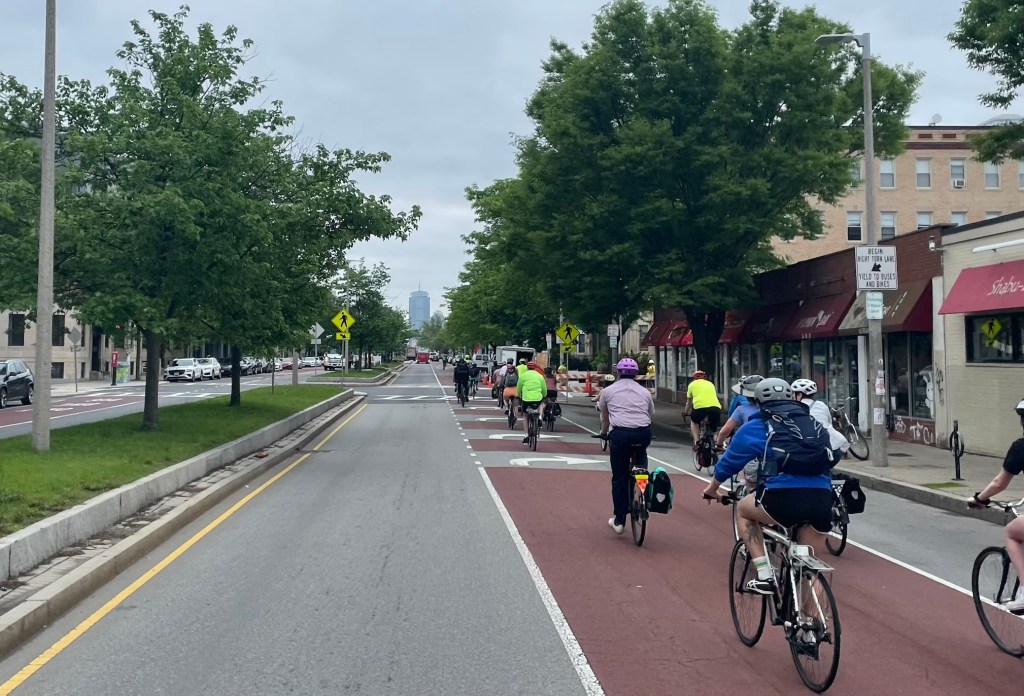
We can do this for a bicycle rider as well. Weight cost is $0.001 per mile plus size of 1/15 cent per foot (bicycles require 1/3 as much lane width as cars) times 5 feet gives us 5/15 = $0.0033 per mile. There is no speed element or fixed base cost with bicycles so we’ve got $0.0053 per mile or $0.05 for a 10 mile journey.
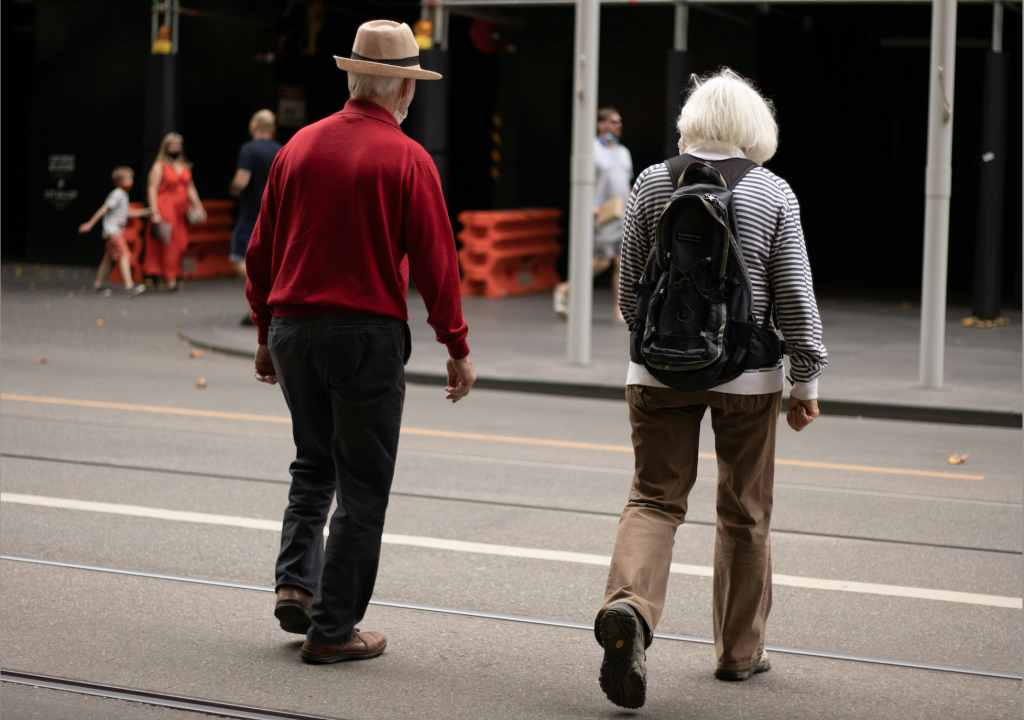
A pedestrian costs about 2 cents for that 10 mile journey (and the cost of a pint after walking 10 miles).
So a cyclist who travels 1,000 miles would pay $2. In other words, charging a “fair share” wouldn’t be worth the cost of administering the fee.
Elsewhere on the Network: Bike Walk KC shows off Kansas City’s new plan for its first protected bike lane. The League of American Bicyclists reveals the results of a survey about policy priorities from bike advocates around the country. And the City Fix says the key to making driverless cars safe is to ensure they travel at speeds that won’t harm people in urban areas.

Read More:
Streetsblog has migrated to a new comment system. New commenters can register directly in the comments section of any article. Returning commenters: your previous comments and display name have been preserved, but you'll need to reclaim your account by clicking "Forgot your password?" on the sign-in form, entering your email, and following the verification link to set a new password — this is required because passwords could not be carried over during the migration. For questions, contact tips@streetsblog.org.