Chicago to St. Louis Is the High-Speed Rail Test America Can’t Afford to Fail

The Chicago to St. Louis corridor could someday become the midwestern backbone of a national high-speed rail network — but an upcoming political deadline could sink the project before it starts, advocates fear.
Lawmakers in Illinois are fighting to pass new legislation governing Illinois’ High Speed Rail Commission, which will sunset in 2027 unless House Bill 4442 successfully extends the program through 2030.
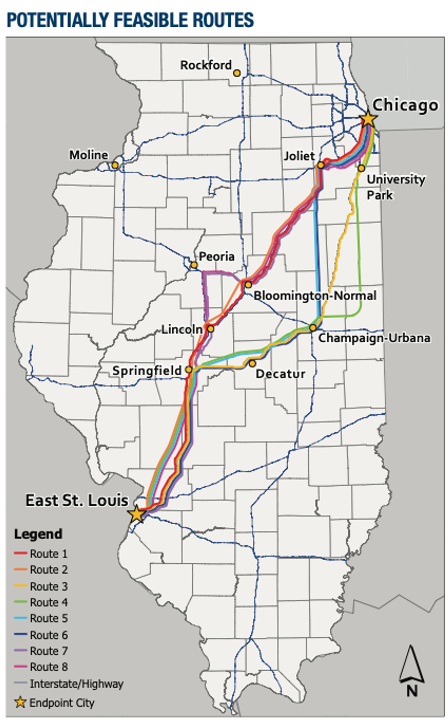
That decision could determine whether the CHI to STL corridor continues to the design and implementation phase, garnering more chances for federal funding — or else shutter the coordinating body behind one of the nation’s most advanced high-speed rail efforts.
For advocates like Rick Harnish of the High Speed Rail Alliance, though, the decision has even more significant implications for the prospect of train travel across America. Unlike many proposed HSR lines, the corridor is almost entirely contained within a single, centrally-located state, making it a uniquely convenient one to develop as well as a critical piece of any eventual high-speed network. And if transportation officials can push the project forward, it could set the stage for more complicated interstate routes in the future.
“It’s the test case that gets the other states around to start going,” Harnish said.
Why this corridor makes sense
Harnish explains that while midwestern high speed rail hasn’t gone full steam ahead just yet, it certainly isn’t starting from scratch. Illinois has spent two decades upgrading service on its existing Lincoln Service train line to be one of the fastest in the nation, reaching up to 110 miles per hour today.
Moreover, the Windy City has already been the nation’s busiest rail hub for the past 150 years — and even if the Gateway City isn’t Harnish’s first-choice destination for its speed line, it’s certainly the most feasible major city with which it could connect.
“You’ve got to get started somewhere,” said Harnish, who serves as the Alliance’s executive director. “The best market location to do a true high-speed line would be Chicago to Indianapolis … The challenge there is, it’s two states. So, the best one that’s in one state is Chicago to St. Louis.”
Of course, Illinois wouldn’t be the first high-speed rail line in America — even if advocates believe it could be one of the most pivotal. While the state of California’s and Brightline’s HSR efforts have proved the demand for faster intercity travel, both are coastal projects that were planned and constructed mostly in isolation.
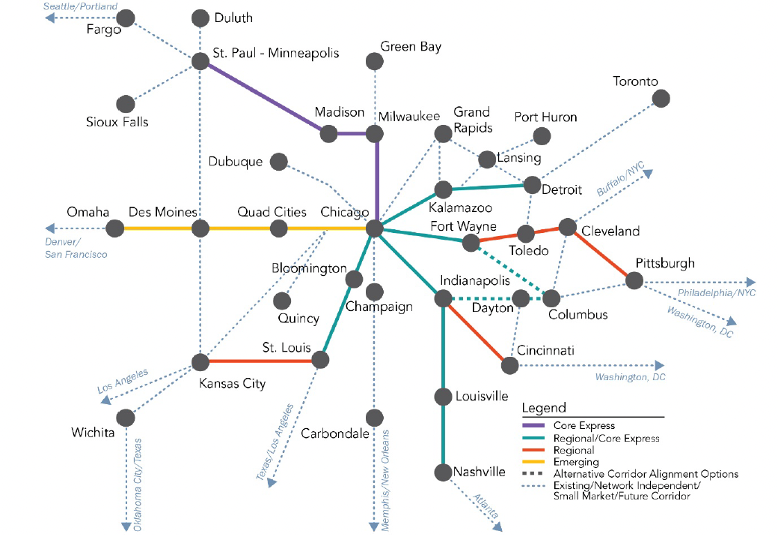
The Midwest, though, could provide a national blueprint for more interstate lines. And because Chicago has rail corridors radiating in nearly every direction, Harnish argues a successful CHI–STL line would not simply connect two cities; it would establish a foundation for extensions to Kansas City, Minneapolis, Detroit, Toronto, Nashville, and beyond.
“This is really about making Chicago and St. Louis work as one agglomeration,” Harnish said, arguing that regional integration is key to making HSR so transformative.
Frequency will be critical, too. At their September 2025 meeting, IDOT’s commission discussed hourly or half-hourly trains, long headways which Harnish argues would undersell the technology entirely.
“A modern double-track railroad can handle a train every three or four minutes,” he said. “I don’t understand why you’d spend all the political capital to build a railroad that can only run one or two trains an hour.”
During a visit to Japan, he recalled seeing departures between Tokyo and Osaka — roughly the same distance as Chicago to St. Louis — leaving every few minutes.
“That’s essentially a 300-mile subway,” he said.
If Illinois can achieve similar success, Harnish argues it would demonstrate a repeatable model: upgrade an existing corridor, coordinate regionally, and expand outward into a network. Failure, though, would reinforce the perception that the United States cannot sustain long-term transportation transformation.
The real obstacle: political priorities
If America wants to achieve high-speed rail coverage on par with Japan, Harnish says the greatest barrier won’t be technology or geography. It will be the politics of how states spend transportation money — especially when those states simply do not view passenger rail as everyday transportation.
And right now, outside a state or two in the northeast corridor and California, sustained investment into HSR remains rare.
“Pretty much that’s it, for good passenger rail programs,” Harnish said. “We’ve got to get the 48 [contiguous] states thinking about passenger trains.”
Illinois itself doesn’t have a spotless track record when it comes to making passenger rail a priority. Between 2018 and 2023, the state ranked sixth nationally in per-capita transit spending — yet spent nearly double that on roadway expansion over the same period. Missouri, meanwhile, devoted an even smaller fraction of its transportation spending to transit, advancing a major expansion of Interstate 70 instead.
Advocates say that imbalance is not Midwestern in nature; it’s a reflection of national priorities. Federal surface transportation funding still heavily favors highways, with the infamous 80/20 split reinforcing car dependency even as climate goals and public health crises beg for mercy. According to Transportation for America, about 87 percent of state DOT funds come from formula pots that are highly flexible.
Harnish put it bluntly: states can shift funding toward passenger rail, “but they choose not to.”
The choice ahead
Harnish warns that the next few state and federal budget cycles will determine which corridors receive transformative investment — and which are left waiting decades for another opportunity. On Sep. 30, the end of federal fiscal year, the landmark Infrastructure and Investment Act’s funding expires, and state budget appropriations are due right around the corner on June 30.
In some ways, in Illinois is a microcosm of all US rail projects over past decades — as well as the resilience of their supporters.
Thankfully, Harnish emphasizes that every state has supporters of mass transit, and encourages advocates to reach out to their state legislators in transportation commissions, joint legislative committees, and appropriations committees, where they will negotiate budgets in spring sessions ahead of the FY27 start on July 1.
And if the highway program can win reliable federal support despite decades of failing to deliver on its goals, Harnish hopes that rail projects like Chicago to St. Louis can finally get their chance to prove themselves.
“This highway program that spends a lot of money on not so productive things,” he said. “Why don’t we have high speed rail yet?”

Read More:
Streetsblog has migrated to a new comment system. New commenters can register directly in the comments section of any article. Returning commenters: your previous comments and display name have been preserved, but you'll need to reclaim your account by clicking "Forgot your password?" on the sign-in form, entering your email, and following the verification link to set a new password — this is required because passwords could not be carried over during the migration. For questions, contact tips@streetsblog.org.