Philly Rolls Out Bike Lanes at a Snail’s Pace, and Mayor Jim Kenney May Slow Down Progress Even More
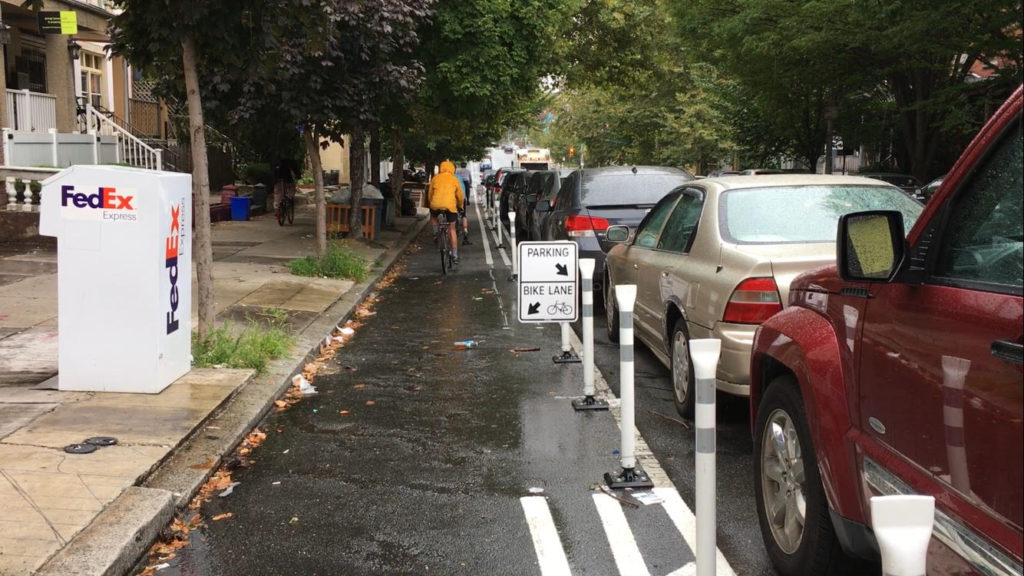
Since 2007, New York City has built 98 miles of protected bike lanes. In the same time frame, Philadelphia has built just 2.5 miles.
Thanks to the narrow streets, bicycling in Philadelphia is still relatively high compared to most American cities. But the city has barely begun to tap the potential for street redesigns to reduce traffic dangers and make cycling appealing to people of all ages.
One reason for the slow progress is a special rule, enacted in 2012 as part of the city’s complete streets policy, that gives each City Council member veto power over bike lanes if a regular travel lane or parking lane is impacted. Before a bike lane can be implemented, it must have the explicit endorsement of the council member representing the district.
The main effect is to drag out the process of installing street safety improvements. Getting “approval for a single, one-mile stretch” of bike lane “can require years of consensus building,” writes Samantha Melamed at the Philadelphia Inquirer.
That’s what happened on Chestnut Street in West Philadelphia. After six years of advocacy and organizing for a protected bike lane on a dangerous 11-block stretch of the road, the city finally implemented the project. But then Council Member Jannie Blackwell, who had been a supporter, received some pushback from constituents and said she wanted to reevaluate the bike lane after three months.
The Chestnut Street bike lane is still in place, but Blackwell wants to make it harder to build similar projects. She recently introduced a bill that would give council members veto power over all bike lanes. Currently, the city is not legally obligated to get approval in some of those cases.
If enacted, the rule could disrupt the city’s plans to convert painted several bike lanes to protected bike lanes.
Dena Driscoll, a mother of two and co-chair of the advocacy group 5th Square, says the rule makes the work of advocating for safer streets much more difficult.
Recent expansions of the bike network have set off a backlash among some residents who intensely object to repurposing parking spaces or simply encouraging more people to bike. Advocates may get 800 signatures in support of a bike project, said Driscoll, but if a few people highly active in local politics oppose it vociferously enough, that may be enough to kill it.
Council members “are listening to some of the loudest voices,” she said. “There’s no clear way to know if we’re going to get their support or not get that support.”
In some neighborhoods, she said, the addition of bike lanes is associated with gentrification. In other cases, bike lane upgrades in affluent neighborhoods trigger backlash.
When Mayor Jim Kenney was elected in 2015, he said his administration would complete 30 miles of protected bike lanes. He has not commented on the legislation. Two years into his time in office, it already seems unlikely that he’ll achieve his promise to improve the bike network.
UPDATE March 8: The Kenney Administration says: “We are continuing our conversations with the Councilwoman about this matter toward a resolution that satisfies the needs of the bicycling community and residents.”
Driscoll transports her young children around the city by bike, and she is exasperated.
“At this point [council members] already have so much power,” she said. “The Kenny administration, they’re still going to the council people to ask for that permission. They’re still defaulting to whatever the council person thinks is the quote-unquote temperature of the neighborhood.”
Updated March 8th to clarify between proposed changes and existing rule.

Read More:
Streetsblog has migrated to a new comment system. New commenters can register directly in the comments section of any article. Returning commenters: your previous comments and display name have been preserved, but you'll need to reclaim your account by clicking "Forgot your password?" on the sign-in form, entering your email, and following the verification link to set a new password — this is required because passwords could not be carried over during the migration. For questions, contact tips@streetsblog.org.