3 Highlights From Elaine Chao’s Very Vague Confirmation Hearing
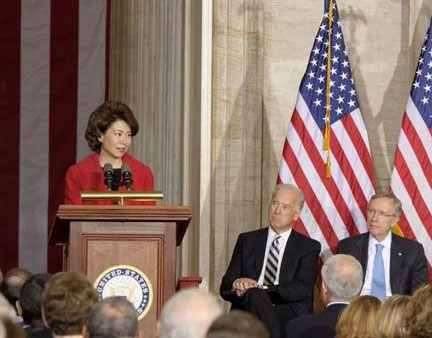
Donald Trump’s pick to lead U.S. DOT, Elaine Chao, was one of three Cabinet nominees to face a Senate confirmation hearing this morning.
Chao, a GOP veteran who served as Labor Secretary under George W. Bush, is a conventional Cabinet choice compared to Exxon CEO Rex Tillerson and Senator Jeff Sessions, two other Trump nominees questioned in the Senate today. Her marriage to Senate Majority Leader Mitch McConnell and her family’s international shipping empire, however, do raise questions about how she’ll manage the agency.
As Transportation Secretary, the pool of funding directly available to Chao would be relatively small. Her influence would derive mainly from regulatory and approval power. This morning she gave a tight-lipped performance that didn’t reveal much about how she would use those levers, but here are three instances where you can try to read the tea leaves.
On Transit
The most alarming moment of the hearing came when Washington Democrat Maria Cantwell asked if Chao would “support continuation” of Seattle transit projects “already in the pipeline.” Voters in the region recently passed a $53 billion transit expansion package.
It was a softball question where supporting the projects would merely signal continuation of current policy, but Chao dodged, saying, “If I’m confirmed, I need to take a look at those projects.”
Federal dollars typically supplement local funding for transit expansions and are indispensable to get projects done. While total federal spending on transit is determined by law, not by U.S. DOT, Chao’s agency will play a role in determining which transit projects get funded. Her tentative answer to Cantwell may not signal any particular policy shift, but uncertainty about federal transit funding commitments is never good.
New Hampshire Democrat Margaret Hassan also pressed Chao on whether the federal government should play a role in funding projects like a commuter rail line in her state. Some right-wing ideologues have called for abandoning federal spending on transit.
Chao didn’t say much in response, but she didn’t come across as a hardliner, either. She noted that “passenger rail is very popular with riders” and that her “father and sisters came down (to the confirmation hearing) on Amtrak.”
“This is an area that can obviously be very beneficial to the environment,” she added, concluding that she has “supported (transit) in the past” and that she “look(s) forward to reviewing it.”
On Pedestrian Safety
Advocacy groups like Smart Growth America wanted senators to raise the subject of pedestrian safety at today’s hearing. Pedestrian deaths rose 16 percent between 2009 and 2014 and now claim almost 5,000 lives each year. During the Obama administration, U.S. DOT took some steps to overhaul federal street design standards to promote safe walking and biking, and it’s an open question whether those efforts will continue.
Throughout the hearing, Chao repeated the line that safety would be her DOT’s number one priority, but she did not express strong support for street safety reforms when prompted.
Hawaii Senator Brian Schatz said his state, which has the highest rate of pedestrian deaths among elderly residents, has been working hard on safe streets efforts, and asked Chao, “Do we have your commitment?”
“I look forward to working with you on that if confirmed,” said Chao.
On TIGER Grants
The Obama administration’s TIGER program is one of the few sources of federal transportation funding that cities and transit agencies can access directly. TIGER has supported many walking, biking, and transit projects, as well as road maintenance, but Congressional Republicans have never warmed to it and repeatedly threatened to zero out funding.
When asked about the program by Hassan, Chao responded: “From all of my meetings with members of Congress there seems to be one area of great agreement and that’s the utility of the TIGER grants.”
Chao added that the $250 million currently devoted to TIGER is a “very modest sum,” and, “I look forward to reviewing it and seeing how much could be devoted to it. “
Now that TIGER is in the hands of the Trump administration, however, the program may fundamentally change. It’s a discretionary grant program, and there’s no guarantee that Chao’s DOT will spend the funds on the same type of projects that Ray LaHood and Anthony Foxx supported.

Read More:
Streetsblog has migrated to a new comment system. New commenters can register directly in the comments section of any article. Returning commenters: your previous comments and display name have been preserved, but you'll need to reclaim your account by clicking "Forgot your password?" on the sign-in form, entering your email, and following the verification link to set a new password — this is required because passwords could not be carried over during the migration. For questions, contact tips@streetsblog.org.