6 Things to Like About Seattle’s New Broadway Bike Lanes (And One to Fix)


Michael Andersen blogs for The Green Lane Project, a PeopleForBikes program that helps U.S. cities build better bike lanes to create low-stress streets.
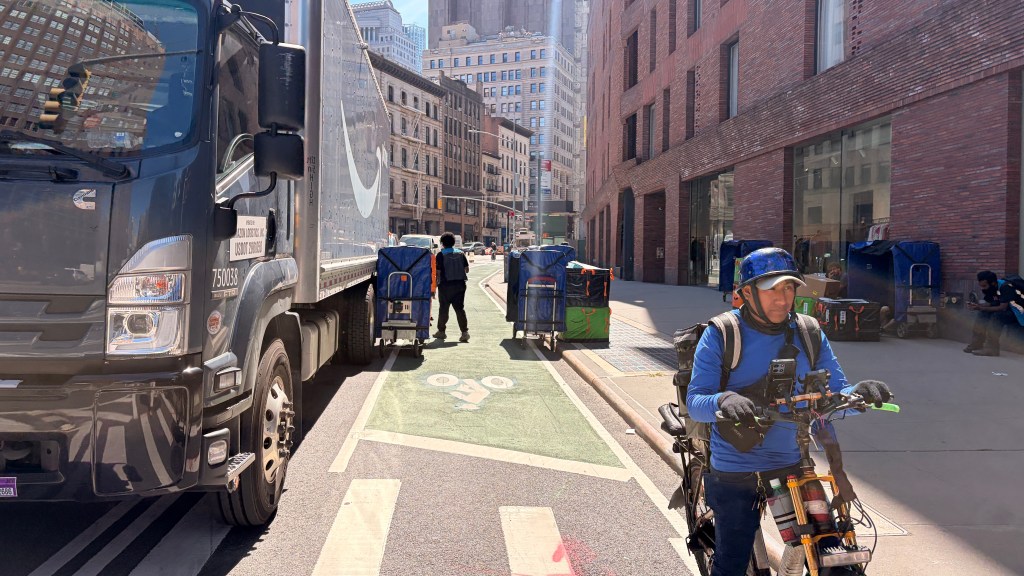
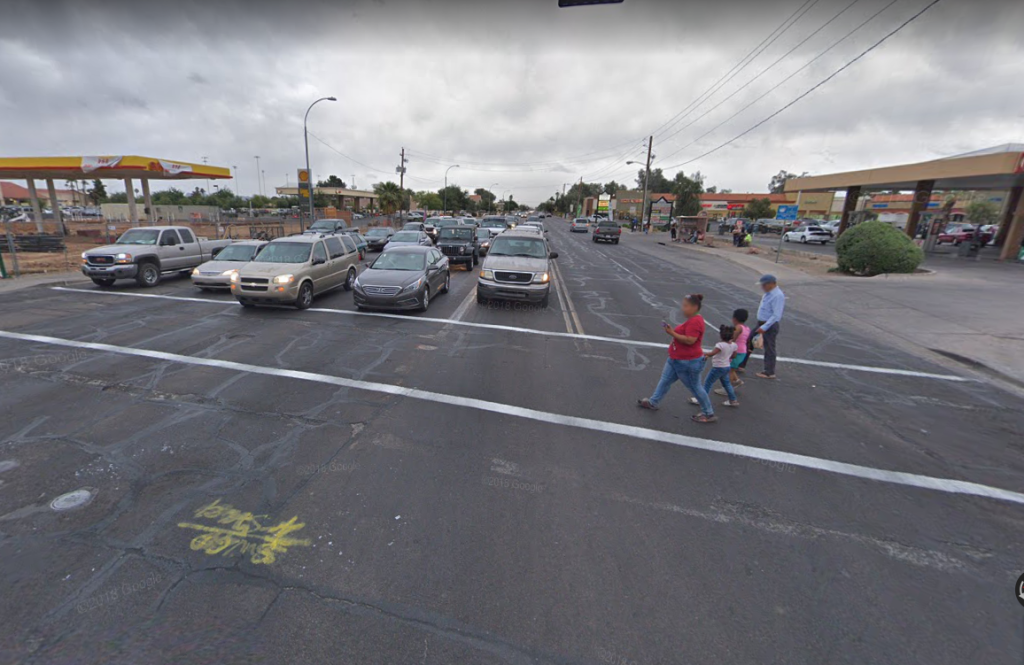
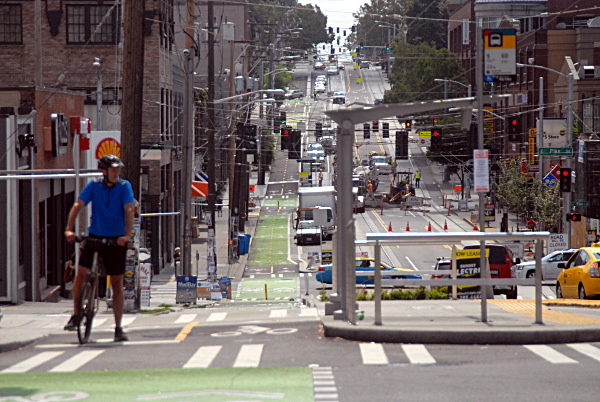
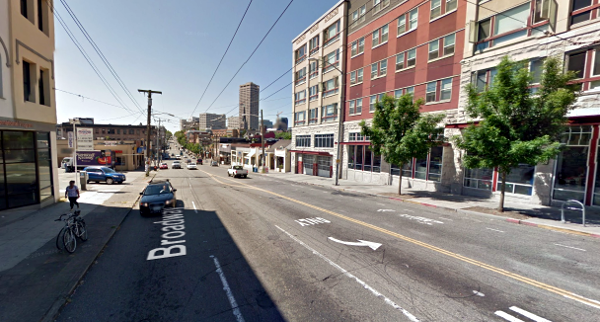
To see how dramatically Seattle has changed Broadway, just above its downtown, by adding streetcar tracks and one mile of two-way protected bike lane, compare the photo above (from Saturday) to the one below (from Google Street View’s capture of the same stretch of road in 2011).
As of this spring, the lanes through Seattle’s First Hill neighborhood connect Seattle Central College, Seattle University, the Swedish Medical Center, a high-density mixed-income housing complex, and a significant commercial node that’ll soon be anchored by an underground light rail stop.
Steve Durrant of Alta Planning and Design, a lead consultant on the project, said the lanes allow biking on a major artery that had been “essentially a forbidden street.”
The lanes were created as part of the $134 million First Hill streetcar expansion, paid for by a 2008 transit ballot measure. With space at a premium on the new street, the 10-foot-wide space immediately east of the northbound streetcar tracks was seen as the only viable way to get bike facilities on Broadway.
The resulting lanes are rare in one important way: they create a two-directional protected lane on one side of a two-way street. That’s a little-used design due to the large number of possible turning conflicts. But Seattle is showing that with enough money and care, it can be done.
I stopped by last weekend to have a look at the project’s unique features.
1) They use creative separation equipment
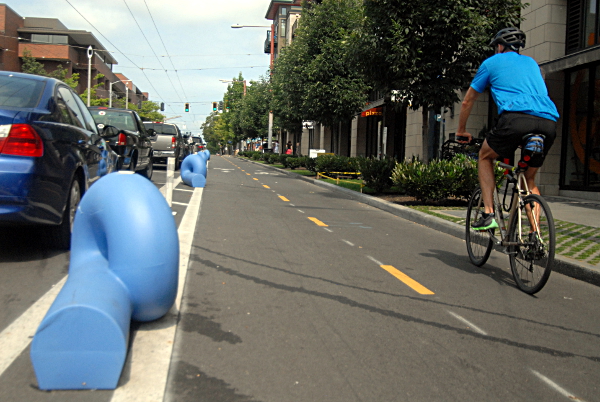
We’re bike lane separation geeks here at the Green Lane Project, but these giant sand-filled blue plastic separators were new to us when Seattle prepared to install them last year. As Seattle Bike Blog put it, Broadway might be the world’s first “Smurf-turd-protected bike lane.” As post-separated lanes around the country are showing their age, Seattle’s choice to use these more durable, visible barriers is looking smart.
2) Every intersection is marked with a green crossbike
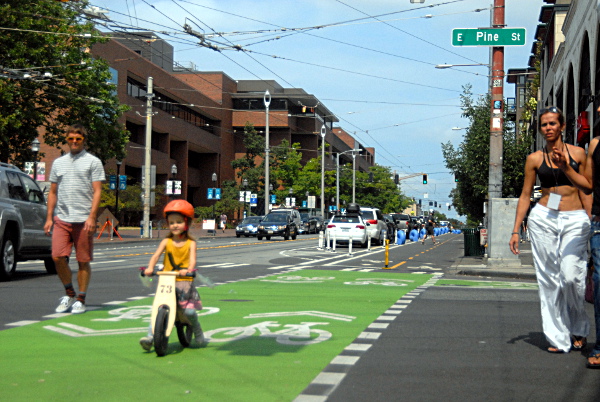
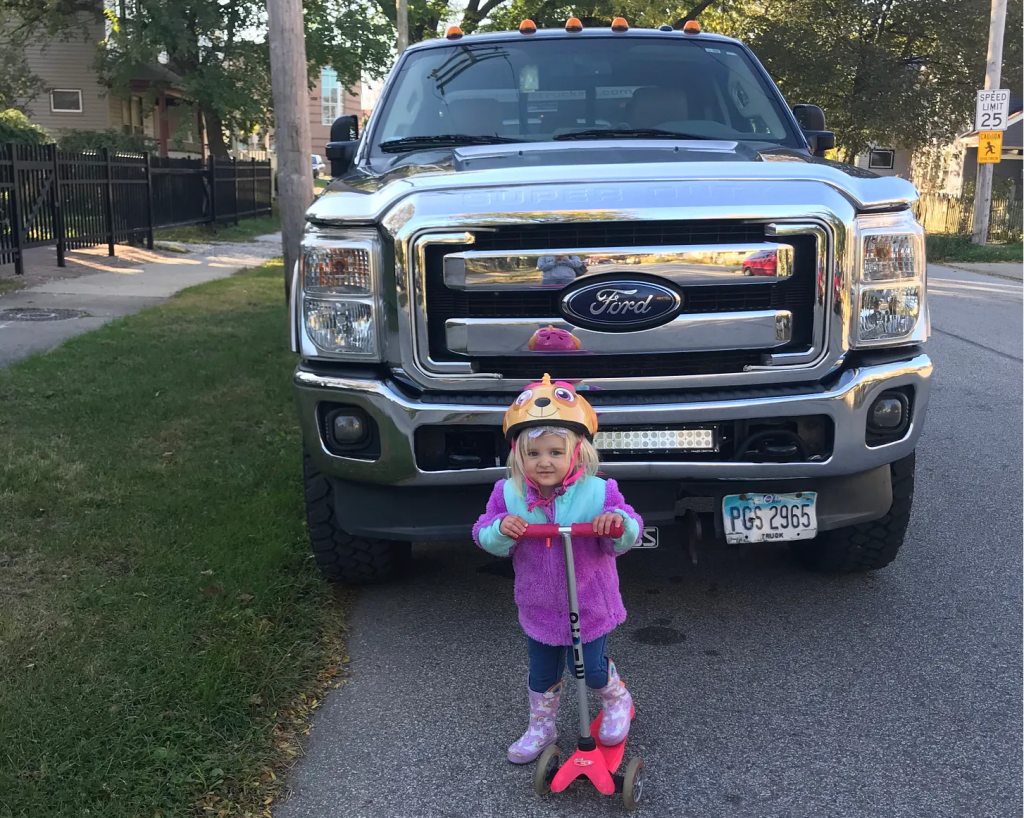
Here’s a scene that hasn’t been seen on streets like Broadway in more than 100 years: a dad helping his daughter practice riding her bike while they head on an errand together.
3) Every driveway crossing is marked in green, too
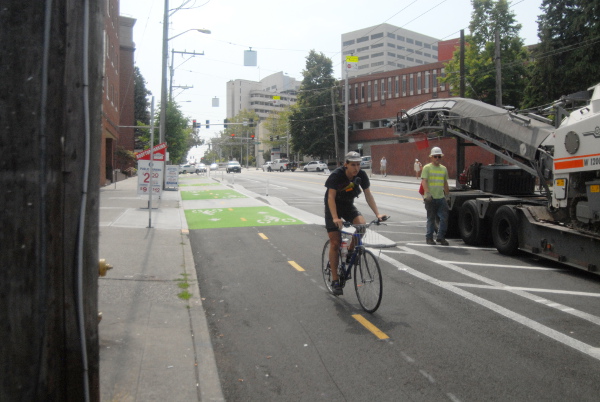
The consistent use of green at street crossings alerts cyclists and drivers to conflict zones. Every driveway along the lanes is marked with green, including the entrances to parking lots (above). (Also, check out the hatched-off areas near each driveway, signifying that drivers shouldn’t park there in order to keep lines of sight clear.)
Next to the lane there is also a busy gas station with a very long curb cut…
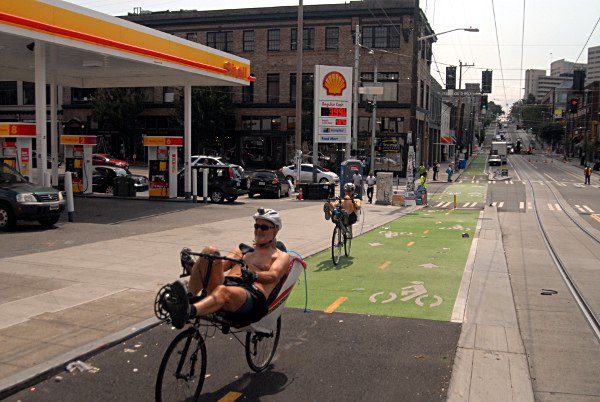
…and little mini-marts.
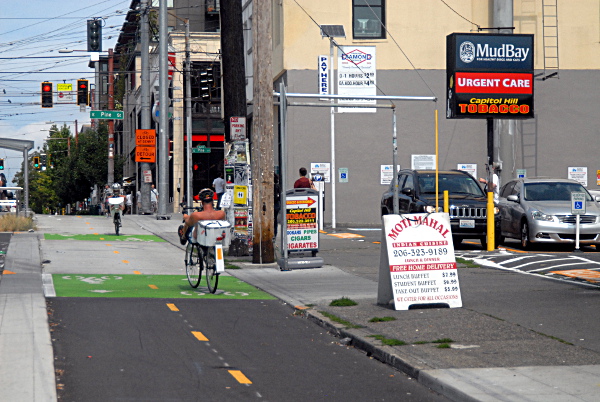
“There are like two, three blocks in there that are really intense with driveways,” Durrant said. “It’s sort of what we were stuck with.” But the result, he said, seems to be fine as long as street users keep their wits about them. “I’ve ridden it now many times, and I haven’t seen a challenge with it.”
4) It rises to sidewalk level behind streetcar stops
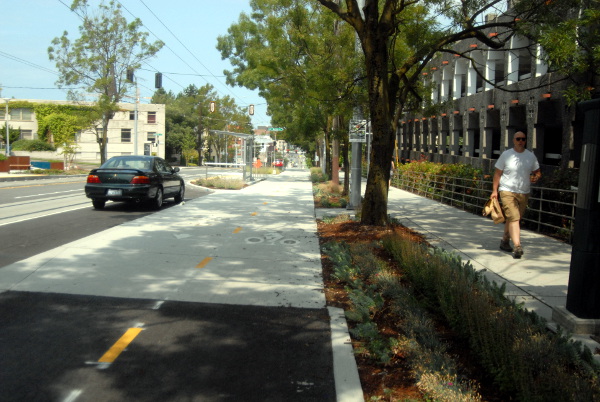
Broadway’s bike lanes actually cut the cost of the associated streetcar project significantly, because they run on top of a water line that would have had to be displaced if the streetcar had hugged Broadway’s east curb. This put the bike lanes between the transit stop and the sidewalk, a setup that’s common in Europe, and works just fine in the United States, but requires some nuance.
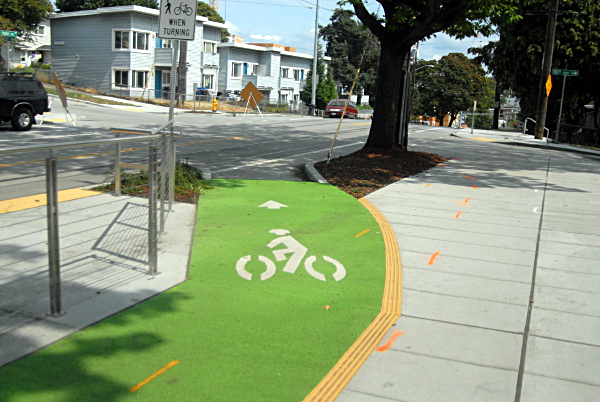
Here, designers raised the bike lane to sidewalk level for cyclists as they approach the transit stop, communicating to people pedaling that (like a car on a raised crosswalk) they’re no longer in their own space and should yield to pedestrians.
Here’s a similar design on Yesler, at the south end of Broadway’s protected lane:
5) It has a dedicated bike signal at every intersection
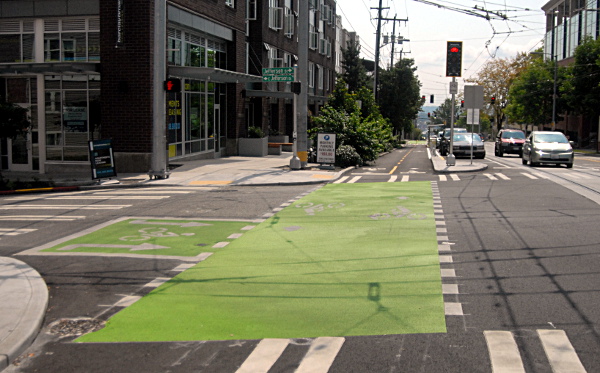
Seattle has one of the country’s stiffest standards for traffic signals along protected bike lanes: At every signalized intersection — which is, in Broadway’s case, all of them — bikes get either their own signal phase or a three-second head start on motorists after each red light. Sometimes, as above, that means creating a freestanding light post for the bike lane (a significant expense) and sometimes (as below) it means an extra signal box hanging from the same wire as others.
6) Most signals have underground detection loops
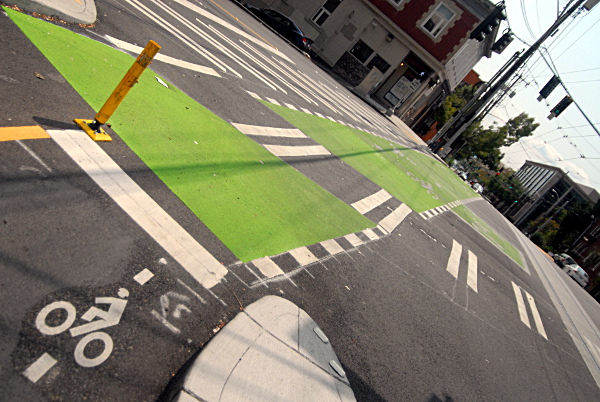
Place your wheels over these vertical white bars and the intersection will detect that someone is on a bike, waiting for a green light. Though these stencils are proven not to be very intuitive, they work — and the more they’re used, the more people will understand how useful they are.
Now, here’s one related problem that seems to have popped up…
7) The “no right turn” signals are often being ignored
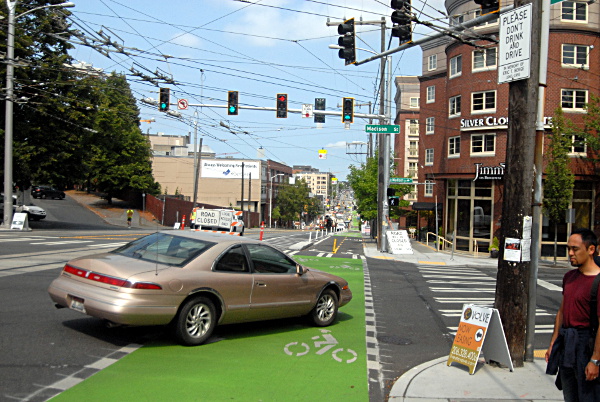
The downside of dedicated signal phases is that many people in cars aren’t expecting them. Above was one of the four drivers I saw approach this intersection while cars had a red arrow but bikes had a green bike signal. Of those, three illegally turned right from their right-turn lane across the bike lane despite a “No turn on red” sign.
I wondered if people were simply looking at the rightmost signal and assuming it applied to right-turning cars without noticing the bicycle shape inside the signal head. One way to fight this misconception would be to put the bike signal lower or on the near side of the intersection, away from those that apply to cars. Another might be for the “no turn” sign to picture a red arrow rather than a red dot.
Maybe this is just one more mark in the case against turn lanes, or the case against right turns on red in general.
Durrant, the designer, had his own suggestion for a fix.
“Enforcement,” he said.
You can follow The Green Lane Project on Twitter or Facebook or sign up for its weekly news digest about protected bike lanes.

Read More:
Streetsblog has migrated to a new comment system. New commenters can register directly in the comments section of any article. Returning commenters: your previous comments and display name have been preserved, but you'll need to reclaim your account by clicking "Forgot your password?" on the sign-in form, entering your email, and following the verification link to set a new password — this is required because passwords could not be carried over during the migration. For questions, contact tips@streetsblog.org.