LaHood Incorrectly Blames 80 Percent of Pedestrians for Their Own Deaths

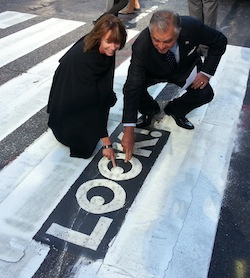
Last week, U.S. DOT Secretary Ray LaHood helped NYC transpo commish Janette Sadik-Khan launch a new phase of the “LOOK!” campaign, with pavement markings instructing texting pedestrians to wake the hell up. He made a comment that made its way into his blog post about the event, as well as other media reports on the event, and it caught the attention of Streetsblog NYC’s crack reporting team.
What LaHood said was that many pedestrian deaths that occurred nationwide in 2010 were easily preventable, as “nearly 80 percent happened because someone was jaywalking.”
That hits like a ton of bricks, doesn’t it? Drivers dart around in powerful, heavy, dangerous contraptions at high speeds while texting, tweeting, eating, and shuffling through their iPods, and it’s the person hoofing it that’s to blame? Eighty percent of the time?
Turns out he was misquoting some data from the National Highway Traffic Safety Administration, which showed that in 2010, 79 percent of pedestrian fatalities occurred at non-intersections. Someone on LaHood’s staff looked at that statistic and figured “jaywalking” was pretty much a synonym for whatever was happening there.
A U.S. DOT spokesperson acknowledged that LaHood was referring to the NHTSA numbers and said, “He was not speaking about the fault or cause of those accidents.”
I don’t know who was ruled at fault in all of those crashes, but I do know for sure that being killed at a non-intersection doesn’t necessarily mean you were jaywalking. Maybe a drunk driver swerved off the road and onto the sidewalk. Or a motorist didn’t look when pulling out of an alley or driveway — U.S. DOT confirmed that curb cuts don’t count as “intersections” in this case. Besides, not all crosswalks are at intersections.
And then there are cases, like that of Raquel Nelson in Georgia, where there simply is no intersection. In suburban areas, you can walk half a mile before you get to an intersection or even a crosswalk. It’s not that no one ever needs to walk across the street, it’s just that planners have ruled that they must take their lives into their own hands when they do.
NHTSA already laid enough blame on pedestrian crash victims with its report, by focusing on how often they were intoxicated. For the secretary himself to say at a major press event that fully four out of five people mowed down by cars were “jaywalking” and therefore at fault is just wrong. It obscures the truth that motorists — not pedestrians — cause the most havoc on our streets.

Read More:
Streetsblog has migrated to a new comment system. New commenters can register directly in the comments section of any article. Returning commenters: your previous comments and display name have been preserved, but you'll need to reclaim your account by clicking "Forgot your password?" on the sign-in form, entering your email, and following the verification link to set a new password — this is required because passwords could not be carried over during the migration. For questions, contact tips@streetsblog.org.