Freakonomics Hucksters: “Save the Earth, Drive Your Car”
Remember those wizards of counter-intuition, the Freakonomics guys? You know, the ones who told their audience that it’s safer to drive drunk than to walk drunk? Well, in his latest piece for NPR’s Marketplace, which ran with the headline “Save the Earth, Drive Your Car,” Stephen Dubner talks to Clemson University’s Eric Morris and arrives at the ridiculous conclusion that driving is greener than transit.

The intellectually dishonest argument rests on the per-passenger energy consumption of cars versus buses. Buses are potentially much more efficient than cars, Morris admits. But many buses are underutilized: The average bus carries just 10 passengers, while the average car carries 1.6. As a result, Morris says, those traveling by bus consume 20 percent more energy per passenger than people driving in cars. (American trains, he concedes, are two-thirds more efficient than cars on this measure, but he qualifies that by saying the “number is warped a bit by the New York City subway, which is just a monster of efficiency.”)
So let’s say you’re an average, environmentally-concerned Joe, and you take this segment to literally mean that you should, in fact, drive your car to “save the earth.” How would that affect the environment? Well, the decision to take transit would consume essentially no additional energy — you would be using the system that’s at your disposal. While driving a car would spew greenhouse gases into the air that would otherwise stay in your fuel tank. It is pretty clear which choice is better for the environment, and it’s the intuitive one.
Midway through the article, after slagging transit with their big, attention-grabbing counter-intuitive point, Dubner and Morris admit that getting more people to use existing transit is unequivocally good for the planet. What they actually want to warn people about is building new transit, which won’t work “in places like Cleveland, Pittsburgh and Memphis” because the routes will be under-used. This, too, is incredibly dishonest.
Places like Cleveland have weakened the transit systems they were endowed with by creating every possible incentive to drive. If anything, the “hidden side” of this issue that Morris and Dubner play up for its counter-intuitive shock value — energy consumed per passenger mile — just points to the disastrous environmental consequences of planning communities around driving. The low ridership on Cleveland’s passenger trains is testament to poor planning, not an indictment of transit. Check out the pedestrian environments around some of Cleveland’s rapid transit stations:
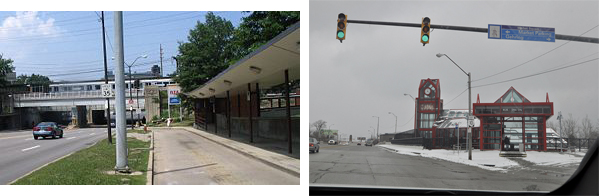
Clearly, many American cities need to repair decades’ worth of damage to the walkable urban fabric that makes transit efficient and well-used. They also need to build better transit so new walkable development can flourish. When Cleveland made a substantial investment in upgrading bus service on Euclid Avenue, ridership shot up 47 percent and a wave of new development followed.
This gets to the biggest omission of all in Morris and Dubner’s argument. They never mention that transit helps create places where people drive less, walk and bike more, and live in much more energy-efficient homes. Professor Robert Cervero at UC Berkeley estimates that transit alone has the potential to curb America’s per capita carbon emissions by 20 percent. When you factor in the energy efficiency that comes along with the type of development transit supports, the number jumps to 30 percent.
Dubner notes at the beginning that New Yorkers have the smallest per-capita carbon footprint in the United States, but he never fully explains why places with good transit like New York, Boston, and San Francisco also have some of the lowest energy consumption rates in the country. There’s no reason places like Cleveland, Pittsburgh, and Memphis can’t join them as green cities with great transit.

Read More:
Streetsblog has migrated to a new comment system. New commenters can register directly in the comments section of any article. Returning commenters: your previous comments and display name have been preserved, but you'll need to reclaim your account by clicking "Forgot your password?" on the sign-in form, entering your email, and following the verification link to set a new password — this is required because passwords could not be carried over during the migration. For questions, contact tips@streetsblog.org.