What ‘Flying Cars’ Could Mean For US Car Culture
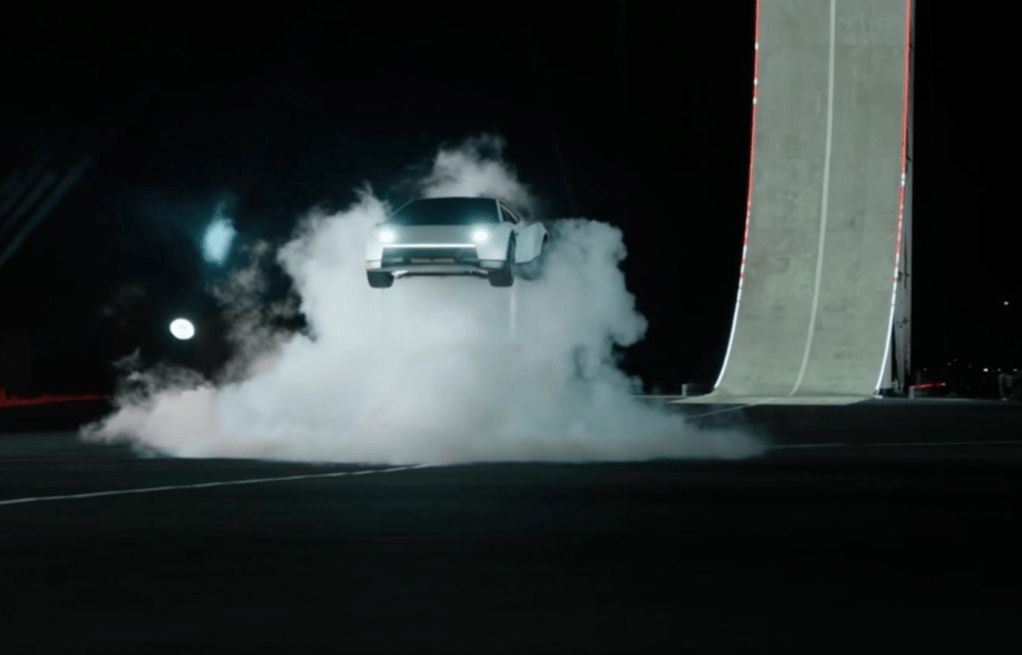
Tesla just debuted its grand vision for a flying car — or at least a fake version of it that experts suspect will never actually be delivered. But could actual urban aviation help end the staggering societal problems associated with terrestrial car dependency, or would it just accelerate them?
Elon Musk made headlines this week with the launch of the new Roadster, which he demonstrated leapfrogging over semi-trucks, clinging upside down to a C-ramps, and flipping in mid-air. A non-flying version of the car requires a $250,000 deposit on Tesla’s website; the price of the flying one is undisclosed, and offered on a “invite-only” basis to select buyers.
The live-streamed marketing stunt was quickly debunked as just another example of technocrat vaporware by scientists like Yann LeCun of NYU, who pointed out that the physics of the tricks would require the car to be nothing but “an empty, lightweight shell containing big compressed air tanks.”
Still, others pointed out that the self-diagnosed AI psychotic/richest man alive isn’t the only one who dreams of flying cars — and as outlets like Aerospace Global News point out, several companies may actually be on the brink of sending “personal electric aircraft” flying over US neighborhoods.
Whether that would be a good thing for the movement to fix America’s car-dominated transportation system on the ground, though, has been a subject of debate.
Even before the automobile was first popularized, inventors around the world dreamed of launching single-occupancy vehicles into the stratosphere, from DaVinci’s conceptual flying machines to the failed 1843 prototype for the “Ariel Hansen Steam Carriage.”
The push to build flying cars really got off the ground, though, with the invention of the helicopter in 1907, which eventually gave birth to the modern “vertical takeoff and landing” vehicle. Often referred to simply as VTOLs, the category encompasses most so-called “flying cars” today, though most of them more closely resemble a small airplane than Tesla’s hovering Hot Wheels fever dream.
Also unlike the Roadster demonstration, most eVTOLs mostly operate in higher airspace above the average delivery drone, but lower than commercial aircraft. But because every trip must obviously start and end on solid ground, many city leaders fear that flying cars would still be deeply disruptive to urban life, as the sound of noisy propellers and whooshing propulsion systems overwhelm communities newly-seeded with “vertiports.”
“There is no way to achieve lift without creating a vast amount of both noise and air disturbance,” researchers at the World Economic Forum warned way back in 2017. “Residents of New York City know this well. Complaints about noise from one of the city’s main helipads on the Hudson River led to increased regulation of tour operators. Yet, even before that legislation, there were fewer than 5,000 tourist flights per month.
“Imagine if all of the city’s eight million residents took even one flight every few weeks: the city would become unlivable,” the report continued.
Some proponents of VTOLs, though, argue that today’s “flying cars” are mostly quieter, electric models — so much so that it’s more common to hear the term “eVTOL” in industry circles, since virtually no models run on gas anymore.
Some even argue that if “vertiports” were carefully planned and centralized rather than haphazard and diffuse, they could become catalysts for car-free walkable neighborhoods, with residents making all their trips locally on foot, bike, or transit — at least when they’re not hopping in a personal electric helicopter to zip across longer distances at aircraft speeds.
In a provocative recent profile, Congress for the New Urbanism explored a San Francisco real estate fund called the Village Project, whose founder Ian Singer argued that widespread eVTOL adoption “would be better to happen in a village rather than sprawl” because “the reality is that you can’t have aircraft landing by everyone’s door; you need a central landing space.”
The company’s website even claims that its vision for a flying car paradise could “shrink the amount of parking and road space needed in a town by up to 60%.”
Many advocates, though, are deeply skeptical of that Silicon Valley vision — and some believe the reality would be the exact opposite.
As urban air mobility lead for the city of Los Angeles, Gabriel Juarez warned Smart Cities Dive in 2022 that her jurisdiction was concerned that “skies full of air taxis could block too much sunlight,” since there’s no evidence that the phenomenon of induced demand is exclusively earthbound. She also worried that mass VTOL adoption could eventually “lead cities to mandate lower building heights, potentially worsening the housing shortage by reducing building density in urban downtowns.”
In a scathing 2020 report for the Center for American Progress, Kevin DeGood even called VTOLs “the technological apotheosis of sprawl,” and “the mobility equivalent of trickle-down economics.”
Far from speeding up commutes for the everyman or liberating new urbanist “villages” from the shackles car dependency, he argued that flying cars would simply empower the wealthy to live in ever-more far-flung homes isolated from the masses — without sacrificing quick access to cities that they could literally drop into from the sky, without so much as laying eyes on another human being with a lower net worth.
Put another way: cheap personal air mobility could unleash a whole new gaggle of Taylor Swifts across America. Everyday people, though, would still be stuck driving regular cars — or waiting on a bus that’s competing with eVTOLs forscarce transportation subsidies.
“”The inevitable reality is that flying cars will confer advantages on direct users while exacerbating the geographic isolation of elites — a spatial manifestation of deepening inequality that undermines the shared experiences that are necessary to sustain democracy,” DeGood wrote.
Of course, there may be some use cases when “flying cars” or technology like them might make sense.
Researchers at Urbanism Next outlined some limited, positive use cases for “urban air mobility,” including aerial delivery drones, which can be a good fit to get supplies quickly to hospitals or to save a delivery truck a long trip to a distant rural area. The same report, though, pointed out that transporting people quickly over medium-to-long distances could be far more cheaply done by investing in high-speed rail, and that many of the other benefits of flying cars are also achievable by supporting walking, biking, and transit.
“Rather than focus efforts on [urban air mobility], cities could invest energies and political capital in backing proven solutions to reduce emissions, mitigate congestion, increase accessibility, and promote equity,” the group wrote.
With “proven solutions” like bike lanes and buses increasingly vilified and weaponized by the federal government and airborne battery technology advancing quickly, though, the future of the flying car may find us sooner rather than later. A few hours before this article was filed, Secretary Sean Duffy granted eVTOL operator BETA a “first of its kind” permit to conduct limited flight operations, and promised to “unleash American innovation in our skies and unlock the future of flight in America.”

Read More:
Streetsblog has migrated to a new comment system. New commenters can register directly in the comments section of any article. Returning commenters: your previous comments and display name have been preserved, but you'll need to reclaim your account by clicking "Forgot your password?" on the sign-in form, entering your email, and following the verification link to set a new password — this is required because passwords could not be carried over during the migration. For questions, contact tips@streetsblog.org.