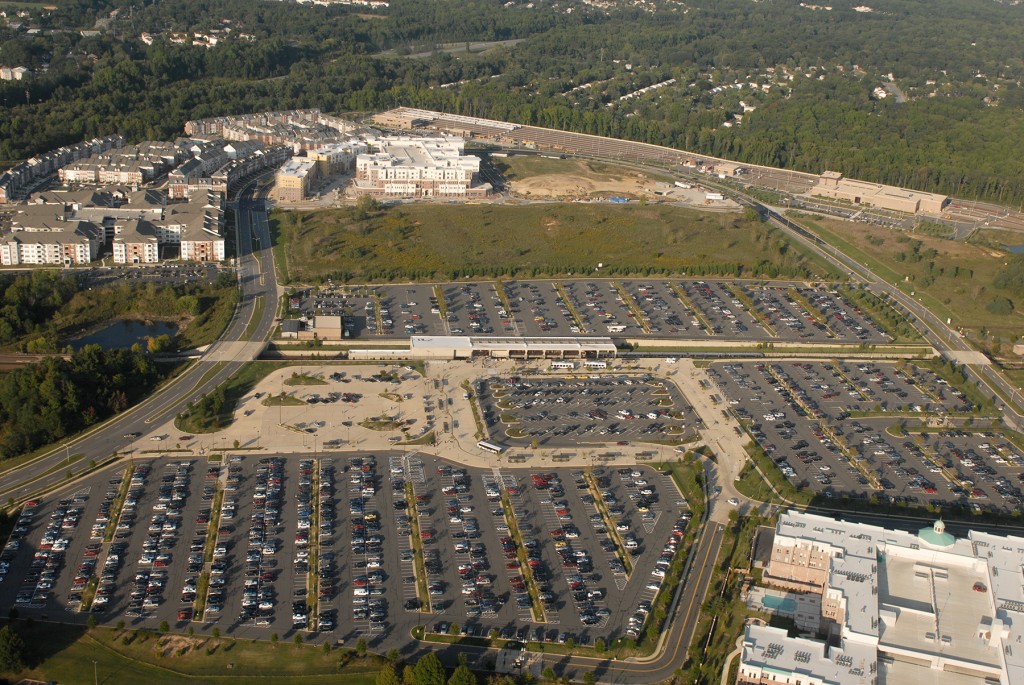
Good transit is rare enough in the United States, and then we make it even less accessible by surrounding stations with parking lots. We saw 16 examples of this wasted transit potential in our 2017 Parking Madness tournament -- including a real stunner in Denver where three light rail stations are marooned in an ocean of parking. In transit parlance, the "first and last mile" connections to these stations are oriented for people who drive, not for people who walk.
Big mistake.
In a post at TransitCenter, Zak Accuardi writes that the walkability of transit stations is of "foundational importance" to their success. While transit agencies often have to go outside their own authority to promote walkable street grids and compact development near their stations, it's worth the effort, Accuardi says:
The buzz around first and last mile connections has recently intensified with emerging mobility options like Uber and Lyft and bikeshare. Much of this buzz is focused on suburban and low-density first and last mile challenges, but agencies would often benefit more by focusing on first and last mile challenges in dense, walkable neighborhoods.
Emerging mobility services open up a variety of possibilities that can help strengthen transit, but they do not change two fundamental truths. First, land use determines transit’s viability; and second, initiatives that subsidize transit riders to obscure land use constraints can be very costly, and thus difficult to deploy broadly. This underscores further why walking access is so important, in both urban and suburban settings.
Improving street network connections that make walking to transit easier is among the most useful and cost-effective first and last mile strategies. Even in relatively dense urban centers, walking to transit can present a challenge. In Washington, D.C., WMATA has done a great, proactive analysis of the likely financial benefit of improving station area walkability, which shows an almost two-to-one return on investment...
Transit-oriented development (TOD) and zoning changes are other highly effective strategies that put more people within walking distance to transit. These strategies are particularly useful in places where transit has been extended to very low density areas, or urban decline or road building has hollowed out areas near older stations. Putting more people closer to high quality transit should be a priority for any transit agency in these circumstances. As we highlight in Who’s on Board, Portland’s TriMet is an agency that has put a lot of hard work into local government outreach for station-area development in the Portland region.
Removing barriers to walking and TOD are likely to yield better ridership and financial return on investment than others designed to draw transit riders from suburban environments—the transportation equivalent of swimming upstream.
More recommended reading today: Seattle Transit Blog reports on the campaign to stop Democrats in the Washington state legislature from cutting $6 billion from a voter-approved transit expansion package. And Bike Portland explains how state legislation to allow cities to set their own speed limits has been watered down.