
In another striking sign of shifting generational preferences, the number of young college graduates is on the rise in central cities across the country -- even in regions that are shrinking overall.
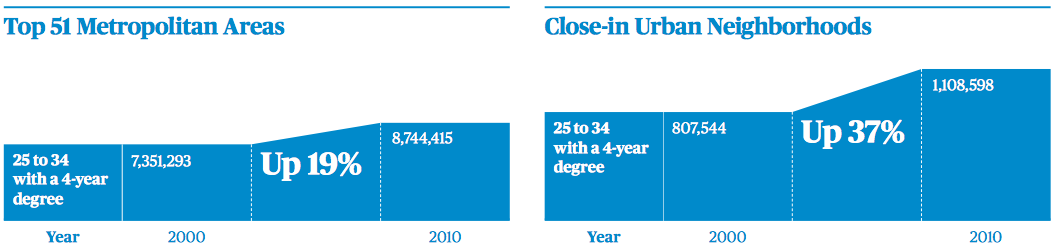
That's according to a new report from City Observatory [PDF], which found the number of 25- to 34-year-olds with college degrees living within three miles of a downtown area has increased dramatically -- 37 percent nationally -- over roughly the last decade. America's total population increased about 11 percent in the same period.
College-educated millennials are even more likely to live in central city areas than their Generation X predecessors. And the trendline is among 51 metro areas examined, just two -- Detroit and Birmingham -- saw a net loss in 25- to 34-year-old college grads living within three miles of downtown.
Interestingly, the total number of people living in America's core cities remained roughly unchanged between 2000 and 2012, at about 9.4 million people. (There was, however, enormous variation by metro region.) The millennial generation is also a larger cohort than the Gen X group that came before them, and more likely to have a college degree, but that doesn't fully explain the trend.
Clearly, shifting preferences are at work, says study author Joe Cortright. The number of young college graduates increased twice as fast in core cities as it did in American metro areas overall.
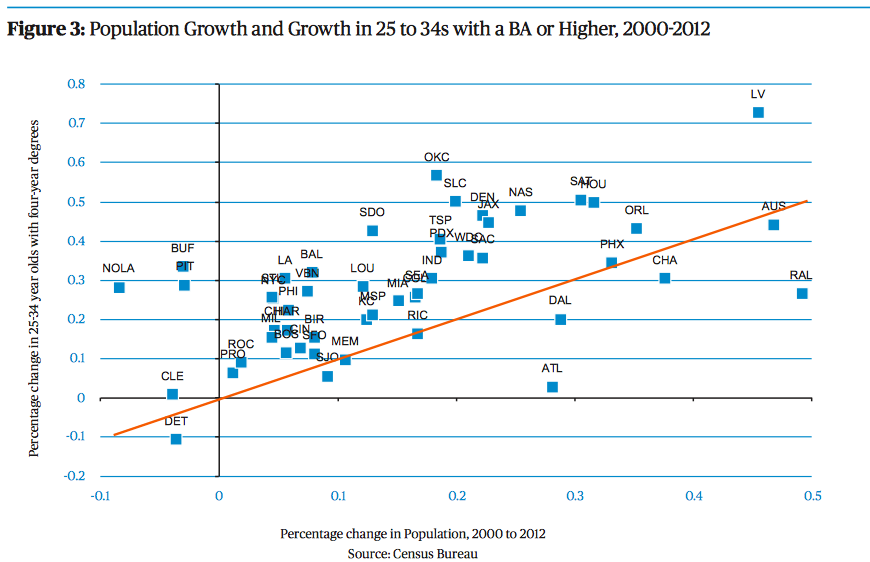
While some of the usual suspects are seeing the greatest change in this demographic (Washington, DC, saw a remarkable 75 percent increase within its core), other cities with large increases in college-educated young people relative to total growth are less expected, including Oklahoma City, Buffalo, and Las Vegas. Meanwhile, some sprawling Southeastern cities -- Atlanta, Dallas, Raleigh and Charlotte -- saw slower growth in this demographic compared to total population gains. Atlanta's lagging performance was in stark contrast to the previous decade, Cortright wrote.
Detroit, meanwhile, experienced an anomalous overall decline of 10 percent. But in some of Detroit's Rust Belt peers, like Pittsburgh and Buffalo, the number increased substantially near the urban core, even while the total regional population shrank.
Cortright says the locational choices of young people with college degrees matter for a couple of reasons. First, this demographic is the most mobile population in the country. It's during this period of life -- before marriage and children -- that Americans are most likely to move across state lines, and those with college degrees are most likely to uproot themselves.
Furthermore, once this group enters their late thirties and early forties, they are more likely to remain in place. So cities that attract these workers are likely to experience lasting economic gains. Within regions, their migration to downtowns could also effect the location of businesses, drawing more employers back to downtown areas.
Cortright says the data shows that cities should be working to create the types of walkable places young people are gravitating toward -- not only to attract college graduates from elsewhere, but also to retain the locals.