Local Climate Doesn’t Exert Much Influence on Biking and Walking
Which state has the highest share of people who walk to work? It’s not temperate California.
Actually, Alaska, the coldest state in the U.S., has the highest rate of active commuting. About 8 percent of workers there commute by foot and another 1 percent by bike.
That illustrates something that researchers have noticed for a long time — climate isn’t a strong indicator of where people walk and bike a lot, or where they do not.
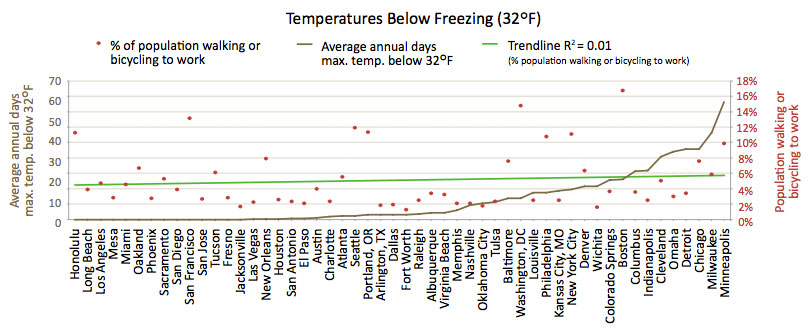
In its big biannual benchmarking report, the Alliance for Biking and Walking cross-referenced climate data from the National Oceanic and Atmospheric Administration with walk and bike commutes rates in U.S. cities. They found only a “weak relationship” between climate and active commuting.
The top chart shows major American cities on a spectrum from the most cold-weather days to the fewest. Note that biking and walking rates are scattered all over the place, even as the cities grow colder from left to right.
When you look at cities that have lots of hot days, though, a relationship does appear. As this chart shows, some of the cities with the lowest bike and walk commuting rates also have some of the hottest days — Forth Worth, Jacksonville, Las Vegas.
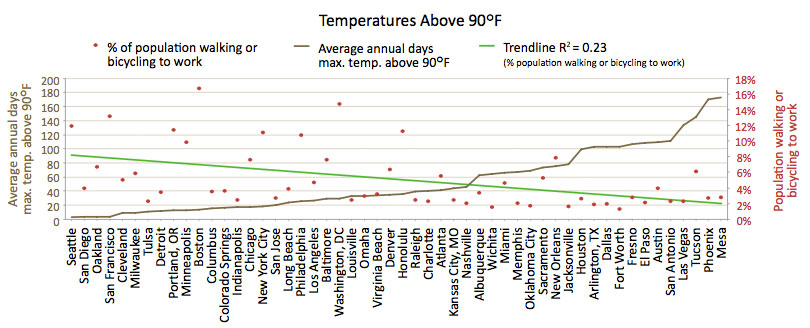
While there is a link between hot weather and lower rates of biking and walking activity, it doesn’t seem to be especially strong.
The connection between car ownership and biking and walking is much more pronounced:
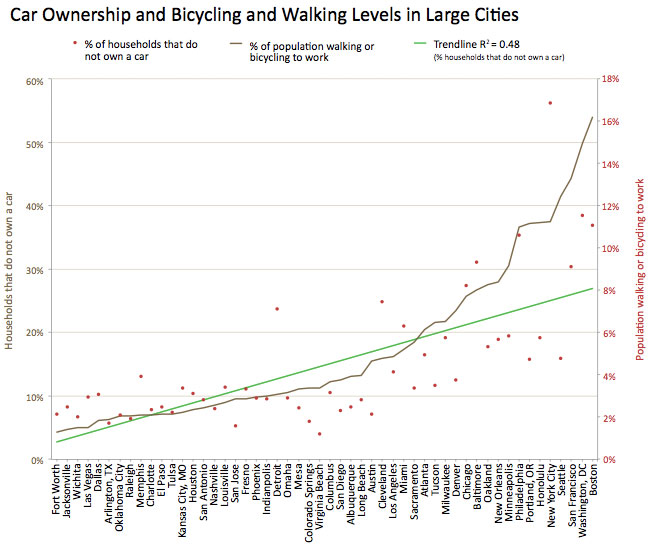
This relationship is fairly obvious, and causality probably runs both ways.
“Those who walk or bicycle a lot are less likely to need or want a car, and those who do not own a car are more likely to need to walk or bicycle for some trips,” the Alliance writes.

Streetsblog has migrated to a new comment system. New commenters can register directly in the comments section of any article. Returning commenters: your previous comments and display name have been preserved, but you'll need to reclaim your account by clicking "Forgot your password?" on the sign-in form, entering your email, and following the verification link to set a new password — this is required because passwords could not be carried over during the migration. For questions, contact tips@streetsblog.org.