TIFIA-Backed, Privately-Operated Texas Toll Road Flirts With Default

It’s been nothing but headaches for Texas State Highway 130. The road — or rather, SH 130 Concession Company LLC, which operates the road — got a credit downgrade to junk bond status in April, and now it’s been deemed even junkier with another downgrade from Moody’s last week. Traffic projections for the road failed to materialize, and so did the expected revenue. Now, the road could end up defaulting on its debts — including a $430 million federal loan.
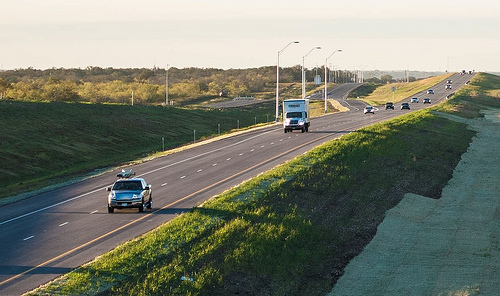
Traffic has been light on the road since it opened a year ago, causing TxDOT to reduce toll rates. Revenues dropped even lower. The operator also convinced the state to give the road the country’s highest speed limit — 85 miles per hour — to lure daredevils onto the road. No dice.
SH 130 is the only part of Texas Gov. Rick Perry’s outlandish Trans-Texas Corridor fantasy that ever got built. The misguided scheme sought to facilitate NAFTA commerce by building a corridor up to a quarter of a mile wide with separate rights-of-way for trucks, passenger cars, freight rail, oil and gas pipelines, and high-speed rail. Luckily, public opposition killed the project.
The 41-mile southern section of the 91-mile SH 130 was largely built, maintained and operated by Madrid-based Cintra Concessiones de Infraestructuras de Transporte. Cintra owns 65 percent of the Concession Company, while San Antonio-based Zachry Construction owns the rest.
It’s the first privately built and operated road in Texas. But the money backing it isn’t all private. The road was financed by a federally-subsidized TIFIA loan.
Moody’s writes that the location of SH 130 should draw traffic from the busy NAFTA route I-35. And yet, the credit rating agency is expecting the Concession Company to use most of its last remaining reserves to pay its debt service in December and to default come June 2014. Moody’s has downgraded the loans – including the TIFIA loan — from B1 (“judged as being speculative and a high credit risk”) to Caa3 (“rated as poor quality and very high credit risk”), with a “negative” rating outlook. It doesn’t have far to fall — there are only two lower ratings than Caa3.
The TIFIA loan was signed in March 2008, long before U.S. DOT was forced to stop considering project merit when awarding loans. Credit-worthiness is now the only factor U.S. DOT is allowed to consider, and this project is clearly in big trouble on that front. The first toll road ever financed with a TIFIA loan, California’s South Bay Expressway, was also TIFIA’s first default, in 2010. Perhaps toll roads aren’t as good a bet as was assumed.
If the SH 130 Concession Company does default, as expected, TxDOT might take it over, and could begin to operate it as a freeway instead of continuing to try to charge tolls. TxDOT has already spent public funds trying to increase traffic on SH 130 by advertising the road and subsidizing the toll reduction. Meanwhile, TxDOT’s 50-mile section of SH 130 is also losing money. Taxpayers have already bailed it out to the tune of $100 million, according to The Examiner.
The road’s failure is also becoming a platform for critics of public-private partnerships, who point out that the public ends up footing the bill if a privately financed piece of infrastructure goes belly up.
The website for the road features a logo with “SH 130” and a mini Texas flag surrounded by a heart and asks, “Can You Love a Road?” The lesson from SH 130 is that it’s not only unloved, it was also unneeded in the first place.

Read More:
Streetsblog has migrated to a new comment system. New commenters can register directly in the comments section of any article. Returning commenters: your previous comments and display name have been preserved, but you'll need to reclaim your account by clicking "Forgot your password?" on the sign-in form, entering your email, and following the verification link to set a new password — this is required because passwords could not be carried over during the migration. For questions, contact tips@streetsblog.org.