The four sparsely populated mountain counties make up the Roaring Fork Valley extend over roughly 50 miles on Colorado's Western Slope. About 32,000 people are interspersed throughout the valley in small towns like Basalt, Carbondale, and Glenwood Springs, but the local economy revolves around the nearby resort town of Aspen.
This, clearly, is challenging terrain for a transit agency. Aspen's hotels and restaurants attract workers from around the region, but people who toil in local service industry jobs have mostly been priced out of the housing near Aspen.
"People who wash pots and pans at the hotels in Aspen were driving 75 miles one way for the privilege of doing that," said Roger Millar of Smart Growth America at the New Partners for Smart Growth Conference in Kansas City last week.
As a result, Highway 82, the main route into Aspen, is the most congested highway in Colorado. Between 1992 and 1994, the Colorado DOT widened Highway 82 to four lanes.
"The DOT said by the time we get finished building four lanes, we're going to need six lanes," Millar said. "And everyone [in town] said, enough with that, we've got to do something different."
Now the Roaring Fork Transit Authority is constructing the agreed upon alternative: a 39-mile bus rapid transit system along Highway 82 that they plan to call, in a bit of marketing genius, the VelociRFTA. When it opens this September, it will be the first bus rapid transit system in the country to serve a rural area.
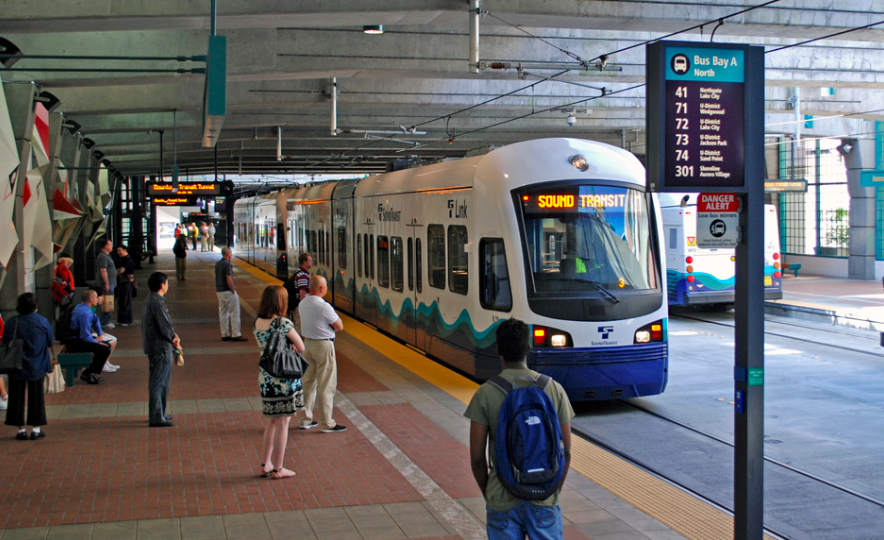
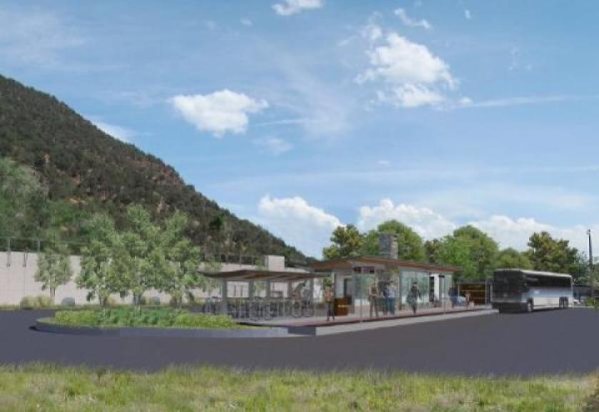
The $40 million project will run buses every 10 minutes at rush hour, stopping nine times along the lengthy journey -- a commuter express route. It will also feature heated waiting stations with bathrooms (pictured above). RFTA officials are encouraging users to walk or bike to the stations.
"It’s just a really really cool system," said Millar. "They’ve put a lot of funding into branding, which is hugely important when you’re doing rural transit."
Founded in 2000 by a vote of seven local jurisdictions, the Roaring Fork Transit Authority has already grown to be the second-largest public transit system in the state of Colorado, hosting about 4.3 million rides annually. The authority runs a bus service that takes commuters to Aspen from the surrounding communities. Then, during the day, it switches to serving tourists, on a private basis.
In 2008, voters in the Roaring Fork Valley approved a four-tenths of a cent sales tax to make the BRT system a reality. The project will also benefit from a Federal Transit Administration Very Small Starts grant.
It's a great example of the kind of creative thinking and pragmatism than can help transit have a real economic impact in rural communities.
"They [RFTA] move about two to three times the per capita ridership of larger cities," Millar said.
There are more than 1,000 providers of transit in rural areas with populations under 50,000, said Sarah Kline, policy director at Reconnecting America, at last week's conference. Most of these providers offer on-demand service, the kind where the rider is picked up at her home and delivered to her destination. But more than 400 rural transit agencies provide fixed-route service, like you see in larger cities and in the Roaring Fork Valley.
Delivering transit service to rural areas is harder than in cities because it involves the expense of transporting people over long distances. But the same forces make rural residents particularly vulnerable to fluctuations in gas prices, especially if they are without viable alternatives.
"Rural areas have become more isolated over the last few decades as options such as intercity rail have been shrunk back," she said.
Many rural communities around the country, like the Roaring Fork Valley, are managing their transit systems skillfully. Kline said it's very important for each rural community to understand what the geographic challenges are, and to design their interventions accordingly.
Another great success story comes from tiny Allendale County, South Carolina. This community was able to vastly improve on-demand transit service simply by hiring a mobility coordinator to reduce redundancy between the existing providers. Use of the Allendale County Scooter "skyrocketed," Kline said, without the county even having to invest in additional vans or drivers.
And how about Sanford, Maine, whose trolley system, a public-private partnership, manages to serve both tourists on the coast and the inland workers who commute there. Blaine County, Idaho, operates a seven-day-a-week, fixed-route transit service that sees a half million trips annually.
"There are things like downtown circulators being started in smaller towns. There are transit hubs and intermodal facilities and improved connections through intercity passenger rail and commuter rail," Kline said. "So there really is a wide variety of interesting stuff going on that's really exciting."