Skip to Content
Streetsblog USA home
Log In
Houston

Houston Rolling Back Parking Requirements

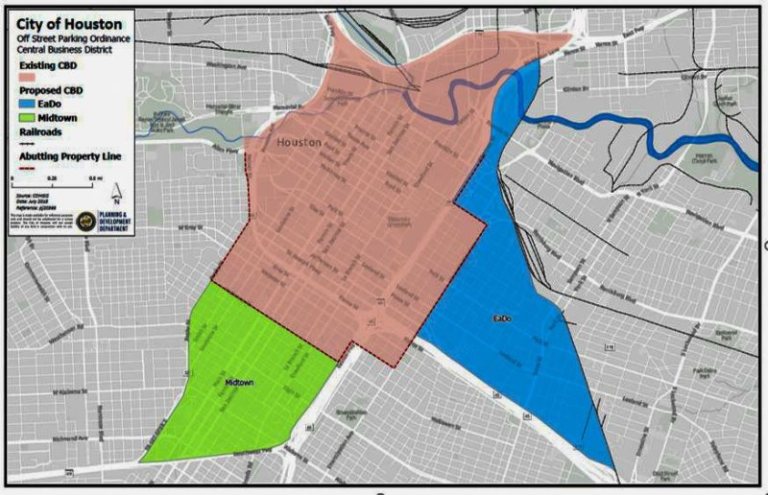
The green and blue areas will no longer have to comply with Houston’s minimum parking requirements. Map: Houston Planning Commission

Houston took a step toward becoming an "increasingly urban city” this week when lawmakers put the kibosh on minimum parking requirements in two center-city neighborhoods.

The reform, known locally as "market based parking,” allows developers and business owners to decide how much parking they need at their buildings, rather than conform to an arbitrary number imposed by city law.

The change "will lead to better streetscapes in this transition period of becoming an increasingly urban city, which will help us be greener, healthier and a more walkable Houston,” City Councilmember Karla Cisneros said

Part of Midtown and Downtown East will be exempt from the city's minimum parking requirements under the zoning code. The rest of the city, excluding downtown, must construct for example, 1.66 parking spaces for every two-bedroom apartment or 10 spaces per 1,000 square feet of restaurant space.

A lot of research shows these arbitrary parking minimums are poor predictors of actual parking use. Furthermore, they act as a backdoor subsidy for drivers by hiding the cost of parking in rents and restaurant bills.

In neighborhoods like Downtown East and Midtown they also drive up the price of housing, while making traveling by foot and transit harder and less practical. Combined, these two neighborhoods have about 10,000 residents and excellent transit access. And with relaxed parking requirements, there is room for more residential development in the kind of accessible urban setting that Houston has only in limited supply right now.

According to Leah Binkovitz at Rice's Kinder Institute for Urban Research, the zoning exemption measure passed with support from the local business community. Only one council member voted against the bill: Greg Travis, who remarked "Walk for two blocks? It's not going to happen."

Jay Crossley, a long-time Texas smart growth leader and head of the nonprofit group Farm and City "It’s a good step."

But he added "It’s too bad the city will continue to impose car storage mandates for the rest of the city." 

But Margaret Wallace Brown, the city's planning department director, said on Twitter it was a "first step toward moving toward a context sensitive parking regulation system."  So further reforms may be forthcoming.

Lots of cities have been rolling back or eliminating minimum parking requirements lately, including Buffalo and Minneapolis.  

Stay in touch

Sign up for our free newsletter

More from Streetsblog USA

In NYC, Unlicensed Drivers Comprise One-Quarter Of Street Fatalities: Data

Unlicensed drivers are linked to fatal crashes much more often now than pre-pandemic

January 13, 2026

Tuesday’s Headlines Need Exercise

Every hour in a car increases the risk of obesity by 6 percent, while walking a kilometer lowers it 5 percent.

January 13, 2026

Opinion: Stop Asking If People Want to Ride Bikes

"We shouldn’t be aiming to nudge a few percentage points in public opinion. Our goal should be to make freedom of mobility so compelling that people demand it."

January 13, 2026

When the Government Says You’re ‘Weaponizing’ Your Car

Immigrations and Customs Enforcement officers have been brutalizing and killing people who they perceive as threats. Is mass automobility multiplying their pretext to do it?

January 12, 2026

Should Monday’s Headlines Carry a Carrot or a Stick?

Human beings generally don't like being forced to do anything, so Grist wonders whether policies like car bans could actually be counterproductive?

January 12, 2026

Chicago Explores Black Perspectives on Public Transit

"We're not going to fix decades of inequitable investment in one year, and things like the high-frequency bus network and the Red Line Extension are really important, but the work isn't done."

January 9, 2026
See all posts